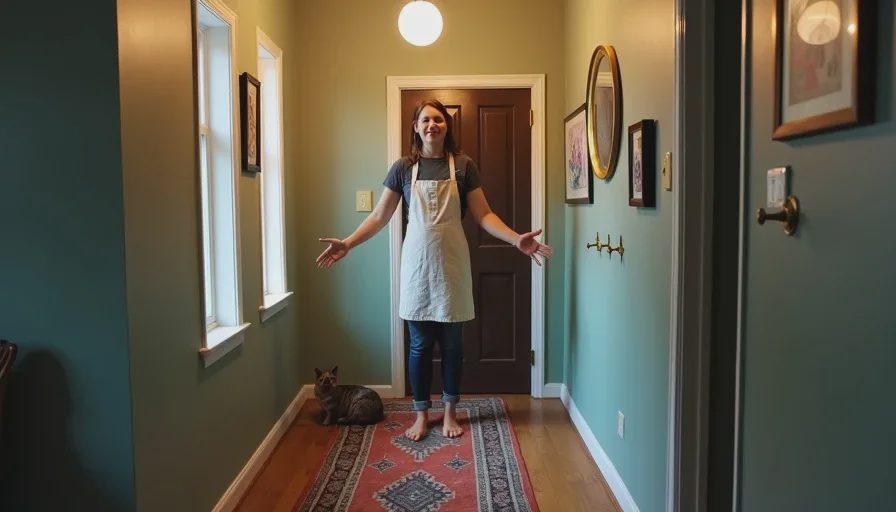
Some rooms come together in a weekend. You paint the walls on Saturday, hang the art on Sunday, and by Monday morning you're drinking coffee in a space that feels brand-new. This hallway was not one of those rooms. This hallway took six months. It took three wrong paint colors. It took a vintage light fixture that sat on my dining table for so long that Felix started referring to it as "the lamp that lives on the table now." It took one terrifying moment when Marcus removed the old ceiling light and discovered wiring that looked like it had been installed by someone who learned electrical work from a cartoon. And it took the slow, stubborn realization that some spaces don't want to be rushed — that the hallway needed to become itself in its own time, and my job was to show up, try things, fail, and try again. This is the story of the most frustrating, most satisfying no-spend room makeover I've ever done — a transformation that cost under $200 and taught me more about patience than any other project in this apartment.
Before: The Tunnel Where Backpacks Went to Die
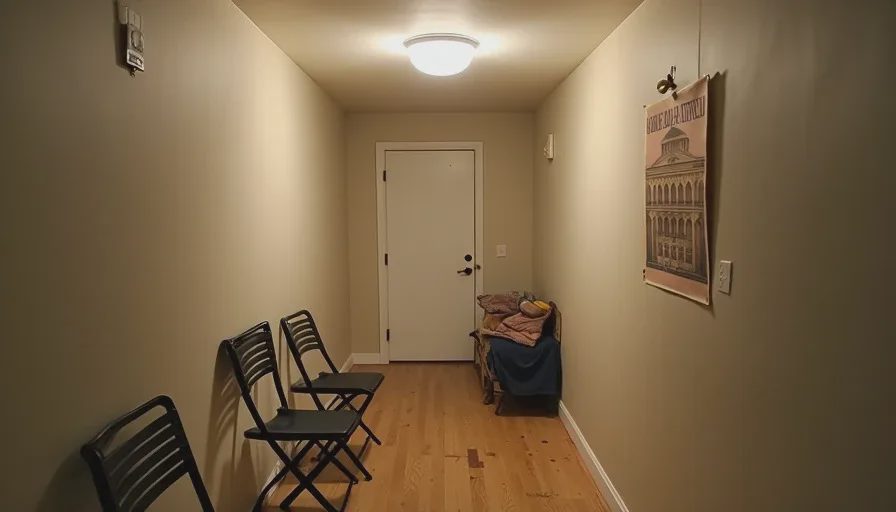
Our hallway is not a grand foyer. It's a narrow corridor — about four feet wide and twelve feet long — that connects the living room to the bedrooms and the one bathroom. There are no windows. There is no natural light. There is only the door at each end, and the walls, and the floor, and the ceiling, and the accumulated clutter of a family of four who treats the hallway as a transitional zone where things go to be temporarily forgotten. Backpacks. Shoes. A single rain boot that has been separated from its partner for so long that I'm not sure the other one still exists. A pile of clean laundry waiting to be put away. A stack of library books that are probably overdue.
For the first five years we lived in this apartment, the hallway was a space we passed through, not a space we were in. The walls were landlord beige — that cold, blue-undertoned off-white that makes every New York apartment look like it's still waiting for the previous tenant to pick up their mail. The ceiling light was a white plastic dome — the kind of fixture that builders install because it costs $12 and technically produces illumination. It cast a harsh, flat, blue-white light that made the beige walls look grey and made everyone's skin look like they were being interrogated. Marcus called it "the boob light," which is the unofficial name for this style of fixture in approximately seventy percent of American households.
I ignored this hallway for five years because I told myself hallways don't matter. They're transitional spaces. You don't spend time in them. You walk through them on your way to somewhere else. But here's what I eventually realized: I walk through this hallway approximately forty times a day. Forty times. Every morning when I stumble from the bedroom to the kitchen for coffee, I walk through the hallway. Every time I go to the bathroom, every time I answer the front door, every time I put away laundry or tuck in a child or retrieve a cat who has stolen something from the kitchen counter and is fleeing the scene — I'm in the hallway. Forty times a day, I was walking through a space that made me feel absolutely nothing except a vague desire to walk faster. That's not nothing. That's forty small doses of low-grade environmental disappointment, every single day, for five years.
The Light That Changed Everything
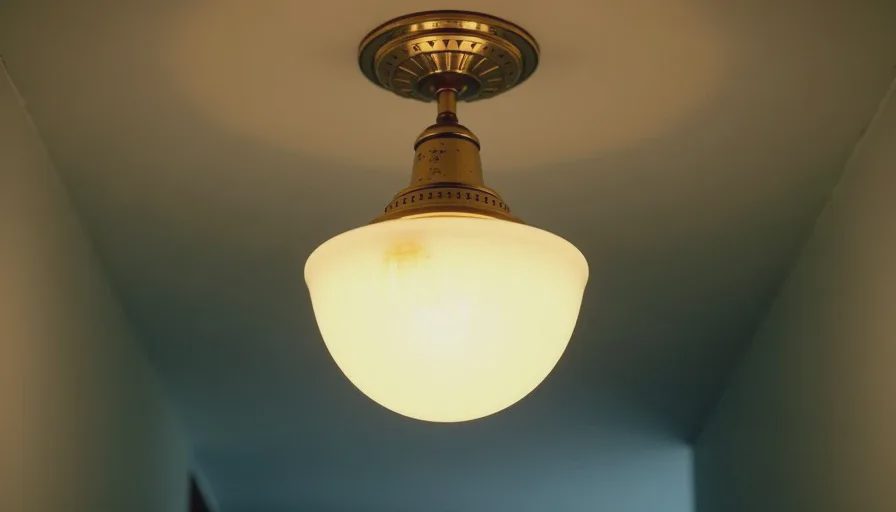
The project started, as so many of my projects do, with a single object I wasn't looking for. I was at the Brooklyn Flea on a Sunday morning, scanning a table of old hardware and discarded fixtures, when I saw it: a milk-glass schoolhouse ceiling light from the 1920s. It had a brass base with a simple geometric pattern, a brass stem, and a large domed shade made of rippled, slightly uneven milk glass. It was heavy — you could feel the quality in your hands. The seller wanted $45. I offered $35, because that's what I do. He took it.
I brought the light home and set it on the dining table, where it sat for six weeks. Six weeks. Every day I looked at it. Every day someone in the family asked about it. "When are you going to hang the lamp?" Marcus asked. "Is that lamp going to live on the table forever?" Felix asked. "Can I have the lamp?" Cleo asked, because Cleo asks for everything. Gouache treated it with the deep suspicion he reserves for all new objects that might be other cats.
I didn't hang it immediately because I was afraid of what I'd find when I took down the old boob light. The wiring in our apartment is old — the building was built in the 1910s, and while the electrical has been updated at some point in the intervening century, "updated" in a Brooklyn rental can mean anything from "professionally rewired in 2005" to "the landlord's cousin added a new outlet in 1987 using a butter knife and optimism." When Marcus finally unscrewed the old fixture — I made him do it, because he's braver than I am about these things — we discovered a junction box full of wiring that was, charitably, vintage. The cloth insulation on the old wires was brittle and cracking. One wire was connected to another with electrical tape that had yellowed to the color of old parchment. Marcus, who is a software engineer and not an electrician but has the software engineer's belief that he can figure anything out with enough YouTube tutorials, looked at the junction box for a long moment and said, "I think we need to call someone."
We called an electrician. A real one, licensed and insured, recommended by a neighbor. He replaced the old wiring in the junction box, installed a new mounting bracket, and hung the schoolhouse light. It took him forty-five minutes. It cost $85. Combined with the $35 I paid for the fixture, the total cost for the new light was $120. That's more than I usually spend on a single element in a room, but it was worth every dollar. The moment the electrician turned on the switch and the milk-glass shade filled with warm amber light — I had bought an Edison-style LED bulb with a color temperature of 2700K, soft and golden — the hallway transformed. The cold, flat, interrogating light was gone. In its place was a warm, glowing orb that made the walls look intentional and the floor look like it had stories to tell. The light didn't just illuminate the hallway. It defined it.
The Paint That Took Three Tries
Buoyed by the success of the light, I decided to paint the hallway. This was my first mistake — not the painting itself, but the confidence with which I approached it. I had painted many rooms by this point. I knew my way around a roller. I thought I could choose a hallway color in one afternoon. I was wrong.
The first color I tried was a pale sage green. I had seen hallways painted in soft sage on design blogs, and they looked airy and serene and vaguely European. In my windowless hallway, under the new warm light, the sage turned into a sickly mint-grey that looked like the walls were quietly nauseous. I lived with it for four days, hoping it would grow on me. It did not. I repainted.
The second color was a warm cream — not beige, but a rich, buttery off-white that I thought would reflect the light beautifully and make the hallway feel wider. Under the schoolhouse light, the cream turned an aggressive shade of yellow-orange, like the walls were slowly turning into butter. Marcus walked through the hallway, stopped, and said, "It looks like we're inside a croissant." He wasn't wrong. I repainted again.
The third color — the one that worked — was a dusty grey-green. Not sage, not mint, not grey, not green, but a quiet, complex mixture of all four. It's the color of old stone covered in a thin layer of moss, or the underside of a leaf in shadow, or the paint on a garden bench that's been weathered by ten years of rain. In natural light it reads as grey. In the warm light of the schoolhouse fixture it reads as green. It changes subtly depending on which end of the hallway you're standing in and which door is open. It makes the brass mirror glow and the children's framed art pop. It's the color this hallway was always supposed to be — I just had to fail twice to find it.
The Rest of the Room: Art, Rug, Hooks, Patience
Once the light and the paint were right, the rest of the hallway came together relatively quickly. I hung the brass round mirror — the one I'd bought years ago, the one that survived the great Command Hook disaster of 2012 because by this point I'd learned to use toggle bolts — on the longest wall, where it could catch the light from the schoolhouse fixture and bounce it around. Below the mirror, I hung three of the kids' framed drawings in a row: Cleo's watercolor cat, Felix's pencil rocket ship, and the family portrait with the circle bodies and line limbs. The frames were all thrifted, none of them matched, and together they looked like a tiny gallery that had been collected over time — which it had.
I found a narrow Turkish runner rug at a secondhand shop for $30. It was faded in all the right places — the reds had gone soft and dusty, the blues were greyed out, the ochres were warm without being loud. It fit the hallway perfectly, running almost the entire length from the living room door to the bedroom door. The first time I walked down the hallway barefoot on that rug, with the schoolhouse light glowing overhead and the grey-green walls holding the light around me, I felt something I hadn't felt in five years of living in this apartment: I wanted to be in the hallway. Not to walk through it. To be in it. To stand there and look at the kids' drawings and feel the rug under my feet and enjoy the simple fact of a space that finally felt like it belonged to us.
The last addition was a row of three brass hooks I found at a flea market for $8. I screwed them into the wall near the bedroom door — into the studs, with actual screws, because I am a person who has learned things — and hung a canvas tote bag on one, Felix's blue jacket on another, and Cleo's yellow raincoat on the third. The hooks solved the backpack-and-jacket clutter problem that had plagued the hallway for years, and they looked good doing it. Brass against grey-green, warm metal against cool wall. The hallway was done.
The Budget Breakdown
I kept a careful record of the costs for this project, partly because I'm a person who keeps careful records and partly because I wanted to prove to myself that a transformation this significant didn't need to cost much. Here's what I spent:
Vintage schoolhouse light fixture: $35 (Brooklyn Flea)
Electrician installation: $85 (licensed professional, worth every penny for the peace of mind)
Edison LED bulb: $8 (warm white, 2700K)
Paint and supplies: $40 (after three tries — I used sample pots for the failures, so the waste was minimal)
Brass round mirror: already owned (originally $15 at a flea market years ago)
Three thrifted frames: $12 total (assorted thrift stores)
Turkish runner rug: $30 (secondhand shop, Carroll Gardens)
Three brass hooks: $8 (flea market)
Total: $218. Let's call it $220. For a transformation that changed how I feel about a space I walk through forty times a day, that's about five and a half cents per walk in the first year alone. The hallway will be here for as long as we live in this apartment. The cost per walk will only go down.
What the Hallway Taught Me About Slow Decorating
I am not a patient person by nature. I want things to be done. I want to paint the walls on Saturday and enjoy them on Sunday. This hallway did not let me do that, and I'm grateful for it. The six months it took to finish — the light sitting on the dining table for six weeks, the two wrong paint colors, the electrician's visit that I had to schedule and reschedule twice — forced me to sit with the process. To live in the unfinished space. To notice things I wouldn't have noticed if I'd rushed.
During the weeks when the light was still on the dining table, I walked through the hallway in its original state — beige walls, boob light, clutter — and paid attention to what bothered me most. It wasn't just the light or the color. It was the clutter. The hallway had no system. Backpacks and jackets and tote bags accumulated on the floor because there was nowhere else for them to go. If I had painted the walls and installed the light in a single weekend, I might not have realized how essential the brass hooks were to the room's function. The delay forced me to understand the space before I finished it.
This is the lesson I want to offer anyone who's in the middle of a project that's taking longer than they expected: slow is not failure. Slow is not indecision. Slow is the pace at which you actually learn what a space needs, as opposed to what you assume it needs before you've lived with it. The rooms in my apartment that came together quickly are the rooms I've had to revisit and adjust. The rooms that took months — the living room, the hallway — are the rooms that feel the most right. They had time to become themselves. I just had to get out of their way.
One Year Later
It's been about a year since the hallway was "finished," though I use that word loosely because rooms are never finished. The schoolhouse light still glows warm every time we flip the switch. The brass hooks still hold the backpacks and jackets and tote bags. The grey-green walls have accumulated a few new scuffs — life happens, even in hallways — and the kids have rotated new drawings into the frames. Felix recently replaced his rocket ship with a drawing of a dragon. Cleo replaced her cat with a self-portrait that makes her look like a superhero. The gallery changes. The hallway stays.
Every morning, when I walk from the bedroom to the kitchen to make coffee, I walk through the warm pool of light under the schoolhouse fixture. I pass the brass mirror, which reflects a sliver of the living room and the deep teal walls beyond. I pass the kids' drawings, which change with the seasons. I pass the hooks with their familiar weight of jackets and bags. And I feel, forty times a day, a small pulse of satisfaction. Not because the hallway is beautiful, though it is. Because it's ours. Because it took the time it needed. Because renter-friendly home decorating isn't about doing everything fast and cheap — it's about doing things right, one project at a time, until the apartment you rent feels like the home you chose.
Letters
No letters yet — be the first to write.