I have tried chore charts. I have tried reward systems. I have tried the thing where you put colored tape on the floor to designate "zones," which worked for about four days before the tape peeled up and became a toy in its own right. I have tried asking politely. I have tried asking less politely. None of these things reduced the daily chaos of two eight-year-olds sharing a Brooklyn apartment as effectively as one thing: moving the furniture.
This is not a metaphor. I am talking about the actual, physical arrangement of sofas and tables and bookshelves and chairs. The layout of our living room — the distances between things, the shapes of the things themselves, the pathways that the arrangement creates — has done more to prevent twin collisions, reduce sibling arguments, and preserve my sanity than any parenting strategy I've ever read in a book. When I say the layout prevents eighty percent of twin chaos, I'm not citing a peer-reviewed study. I'm citing eight years of living with Felix and Cleo, during which I've rearranged the furniture approximately fourteen times and learned, through trial and error and one trip to urgent care, what works and what absolutely does not.
This is the kid-proof home layout post I needed when the twins were two and I was frantically moving every piece of furniture against the walls in the hope that they'd stop crashing into things. They didn't stop crashing into things. They just crashed into different things. The problem wasn't the furniture. It was the layout. And once I figured out the principles I'm about to share, the daily soundtrack of thuds, crashes, and "MOM, FELIX RAN INTO ME AGAIN" dropped by what I conservatively estimate as eighty percent.
The Principle: Movement Needs a Path, Mess Needs a Boundary
Before I get into the specific layout, let me name the two principles that underpin everything. I figured these out the hard way — by doing the opposite first and watching the chaos unfold.
Principle one: Kids need to move. This is non-negotiable. They run. They chase. They spin. They gallop. They do a thing where they kind of skip sideways while making a noise that I can only describe as a siren. If your layout doesn't give them a clear path for movement, they will create their own path, and that path will go directly through the coffee table, the floor lamp, and whatever adult is trying to drink a cup of coffee in peace. You cannot stop kids from moving. You can only give them a place to move that doesn't involve colliding with furniture.
Principle two: Mess needs boundaries. Kids generate mess — art supplies, Lego pieces, half-finished drawings, the contents of their pockets, mysterious collections of rocks and sticks and shiny things they found on the sidewalk. If you don't give the mess a designated zone, the mess will expand to fill every available surface, and you will spend your evenings picking crayons out of the sofa cushions and wondering why there's a plastic dinosaur in the silverware drawer. You cannot stop kids from generating mess. You can only give the mess a place to live.
These two principles — movement needs a path, mess needs a boundary — shaped every furniture decision I've made in the last five years.
The Runway Loop: Why Open Centers Work Better Than Furniture Against Walls
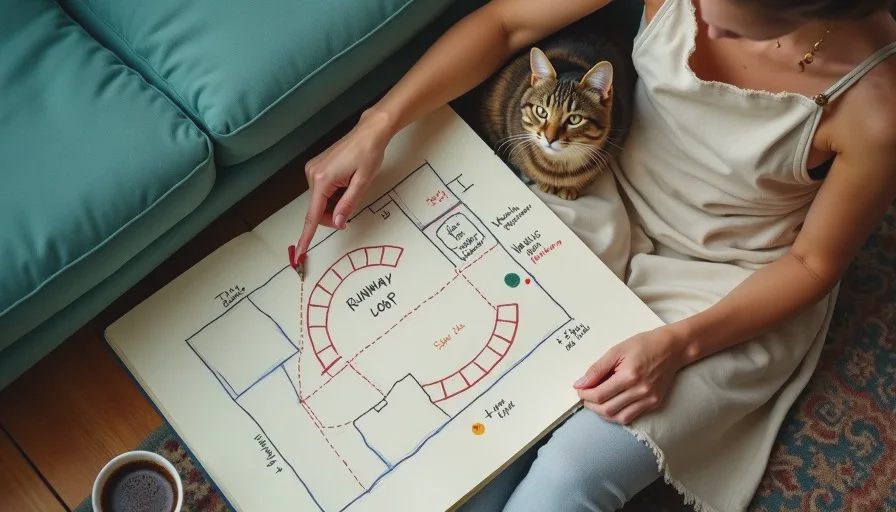
The most common mistake I see in family living rooms is what I call the "perimeter prison." Every piece of furniture is pushed against the walls — sofa against the back wall, bookshelves against the side wall, chairs in the corners — leaving a large empty space in the center of the room. This seems logical. An open center gives kids room to play. But here's what actually happens: the open center becomes a collision zone. Two children, running from opposite directions, meet in the middle of the empty space and crash into each other. Or a child runs through the open center and trips over nothing — because open space doesn't define a path, and undefined space is where falls happen.
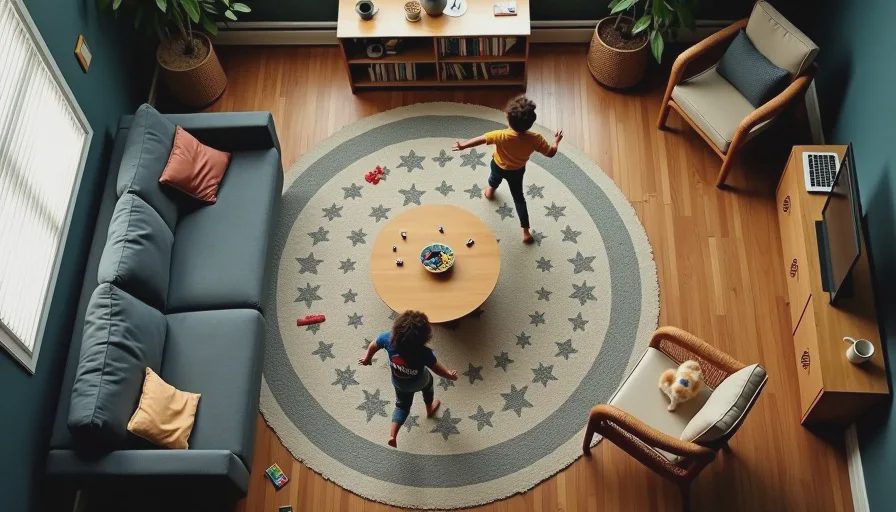
The solution is counterintuitive but it works: put furniture in the center of the room. Specifically, put a piece of furniture — a coffee table, an ottoman, a large pouf — in the middle of the room, leaving a clear loop of open space around it. This creates what I call the "runway loop." Instead of one big undifferentiated open space, you have a defined circular path. Kids run the loop. They chase each other around the loop. They run laps around the coffee table until they're dizzy. But they don't crash into each other, because the loop gives movement a direction — it's a track, not an arena. And they don't crash into furniture, because the only furniture in the loop's path is the central piece, which they're running around, not into.
Our coffee table is round. This is not an aesthetic choice — well, it's partly an aesthetic choice, but it's mostly a safety choice. A round table has no corners to hit. When Felix was three and still unsteady on his feet, he fell approximately four hundred times in the general vicinity of the coffee table. He hit his head on the floor, on the rug, on his own knees, but never on the table, because the table had no corners to hit. A rectangular coffee table in the center of a runway loop is a head injury waiting to happen. A round one is a landmark they navigate around. The difference matters.
The Yes Zone: How to Contain Mess Without Killing Creativity

The second layout principle is what I call the "Yes Zone." It's a designated area — defined by a piece of furniture, a rug, and a clear visual boundary — where the kids are allowed to do whatever they want. Painting. Cutting. Gluing. Building. Taking things apart and not putting them back together. The rule is simple: in the Yes Zone, the answer to "Can I do this?" is almost always yes. Outside the Yes Zone, the answer depends on what "this" is and whether it involves permanent markers near the sofa.
The Yes Zone in our living room is a corner defined by a low wooden cabinet — the $30 flea market trunk that I've mentioned in other posts — and a small rug. The cabinet holds art supplies: paper, markers, crayons, watercolors, tape, scissors, glue sticks, a box of collage materials that I've learned not to investigate too closely. The rug defines the floor area where it's okay to spread out. The boundary is clear: you can make a mess on the rug and around the cabinet. You cannot take the markers to the sofa. You cannot paint on the coffee table. You cannot bring glue anywhere near the cat.
The Yes Zone works for two reasons. First, it gives the mess a permanent home. I don't have to spend twenty minutes setting up an art activity and twenty minutes cleaning it up. The supplies live in the cabinet. The kids get them out when they want to create. They put them back — sometimes, when reminded repeatedly — when they're done. Second, it gives the kids agency. They don't have to ask permission to use the Yes Zone. It's theirs. They own it. Cleo has customized her side of the cabinet with stickers. Felix has taped a hand-drawn "KEEP OUT" sign to his drawer, which Cleo ignores entirely. The Yes Zone is the most-used area in our living room, and it's also the messiest — but the mess is contained to one corner, which means the rest of the room stays functional for the adults who also live here.
Furniture Shapes That Prevent Injuries
I've mentioned the round coffee table, but the principle extends beyond one piece. After the glass table incident — which I've written about before, when Felix nearly brought a forty-pound pane of tempered glass down on himself at ten months old — I developed a rule: no sharp corners in the center of the room. Furniture that lives in the runway loop or its immediate perimeter should be round, oval, or have softened edges. Rectangular furniture should live against walls, where kids are less likely to run into it at full speed.
This doesn't mean your home needs to look like a preschool classroom. Our round coffee table is a beautiful old oak piece with a patina that only improves with time. Our oval rattan ottoman is vintage and adds texture to the room. The key is material and shape, not style. A round glass table is still dangerous — glass breaks. A round solid-wood table with no sharp edges is forgiving. When Cleo tripped over a rug edge last year and fell toward the coffee table, she hit the rounded edge with her shoulder, bounced off, and kept running. If the table had corners, that fall would have ended differently.
Anchoring: The Non-Negotiable Safety Rule
While we're talking about furniture placement, I need to say this as clearly as possible: anchor tall furniture to the wall. Bookshelves, dressers, tall cabinets — anything that a child could pull over on themselves — must be secured to wall studs with furniture straps or brackets. This is not a layout suggestion. This is a safety requirement. I know multiple families whose children have pulled dressers or bookshelves over on themselves. In one case, the child was fine — the dresser landed on the bed instead of the child, through pure luck. In another case, the child spent a night in the hospital for observation. Furniture tip-overs injure thousands of children every year, and the fix costs about five dollars and takes ten minutes. Anchor your furniture. Do it today. I'll wait.
How to Apply This in Your Own Home
If you're looking at your living room and thinking about how to apply these principles, here's the step-by-step process I recommend:
Step 1: Identify the runway. Look at your room and figure out where the natural path of movement is. Where do kids run? Where do they chase each other? Where do they enter and exit the room? The runway should connect these points in a loop, ideally a circle or an oval. If your room is small — and in Brooklyn, most rooms are small — the runway might be tight, but it should still exist. A loop around a coffee table might only be three feet wide. That's fine. Kids are small. They can run in a three-foot loop.
Step 2: Place a central anchor. Put a round or oval piece of furniture in the center of the runway loop. This is what defines the loop — without a central piece, there's nothing to run around, and the space reverts to an undifferentiated collision zone. The central piece should be stable, solid, and corner-free. A round coffee table. An ottoman. Even a large floor cushion or a pouf can work.
Step 3: Push tall furniture against walls. Bookshelves, tall cabinets, dressers — these should live on the perimeter, secured to studs. They define the edges of the room without encroaching on the runway. If you have a piece that needs to live away from a wall — like a room divider — make sure it's wide and stable, not tall and narrow.
Step 4: Create a Yes Zone. Choose one corner or one wall section. Place a low storage piece — a cabinet, a trunk, a shelf — and define a floor area with a small rug. Stock the storage with art supplies, building toys, whatever your kids like to do that generates mess. Make it theirs. Label it if you want — the "YES ZONE" sign on our cabinet has become a point of pride for the twins.
Step 5: Remove or relocate hazard furniture. Glass tables. Sharp-cornered rectangular coffee tables. Lamps on unstable bases. Anything on wheels that isn't designed to be on wheels. These things are accidents waiting to happen. Replace them with safer alternatives, or move them to rooms where kids don't play. Our glass coffee table was listed on Facebook Marketplace within hours of Felix's near-miss. Someone came to get it that same afternoon. I hope they didn't have toddlers.
The Result
After fourteen rearrangements and eight years of twin reality, our living room layout looks like this: a round oak coffee table in the center, a runway loop of about four feet wide around it, the sofa defining one side of the room, the wicker chair defining another, bookshelves anchored to the longest wall, and a Yes Zone in the corner by the kitchen entrance. The room is not large — it's a Brooklyn living room, which means it's about the size of a generous parking space. But the layout makes it feel spacious, functional, and — most importantly — safe for two eight-year-olds who treat the room like an indoor track.
Realistic family home decorating is not about designing a room that looks like a catalog. It's about designing a room that works for the people who actually live in it. For us, that means a room with a runway, a Yes Zone, zero sharp corners in the center, and a cat who has learned to stay out of the loop during peak running hours. The layout didn't eliminate chaos — nothing eliminates chaos when you have twins. But it reduced the collisions, the arguments, and the injuries by about eighty percent. And the remaining twenty percent? That's just life with Felix and Cleo. I wouldn't trade it for anything — not even a living room that stays clean for more than ten minutes.



Letters
No letters yet — be the first to write.