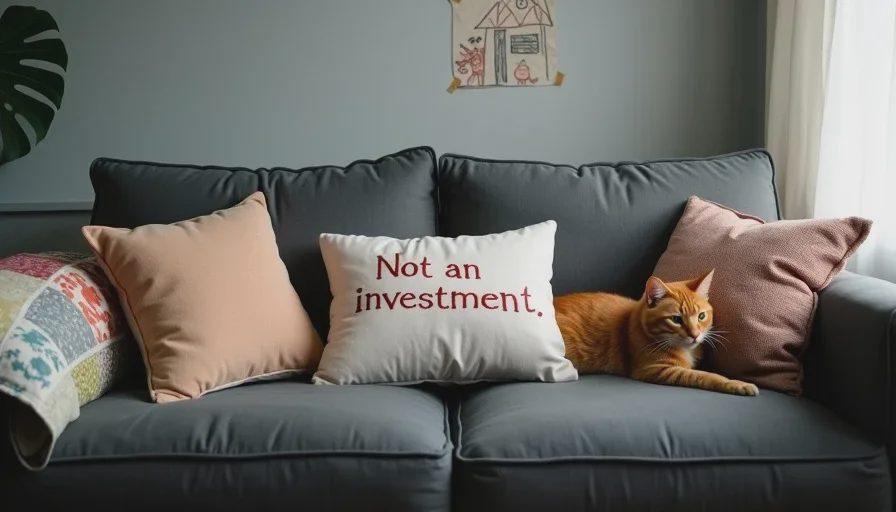
Can we please retire the phrase "investment piece" from home decor vocabulary? Every time a salesperson or an influencer utters those words with a straight face, a small part of my soul shrivels up and dies. An investment, by any reasonable definition, is something that grows in value over time. Your sofa — no matter how much Italian leather it's wrapped in, no matter how many springs were hand-tied by artisans — will not appreciate. It will collect crumbs, absorb spilled coffee, endure the slow assault of afternoon sun through your windows, and eventually end up on Facebook Marketplace for a fraction of what you paid. And that's fine. That's what furniture is supposed to do. It's a couch, not a mutual fund. This is the kind of honest home design advice I desperately needed years ago, before I spent four hundred dollars on a velvet armchair that the twins baptized with grape juice within seventy-two hours of delivery.
The Myth That Keeps Us Staring at Price Tags
The "investment piece" language is brilliant marketing, and I don't blame retailers for using it. They need you to believe that spending more today will somehow save you money tomorrow. But let's look at what actually happens in a home with kids, pets, or just a partner who eats tortilla chips on the couch while watching basketball. A $4,000 sofa might have a kiln-dried hardwood frame and eight-way hand-tied springs — genuinely good things — but if you're terrified to sit on it, if you flinch every time someone sets down a mug without a coaster, then what exactly did you invest in? Anxiety. You invested in anxiety.
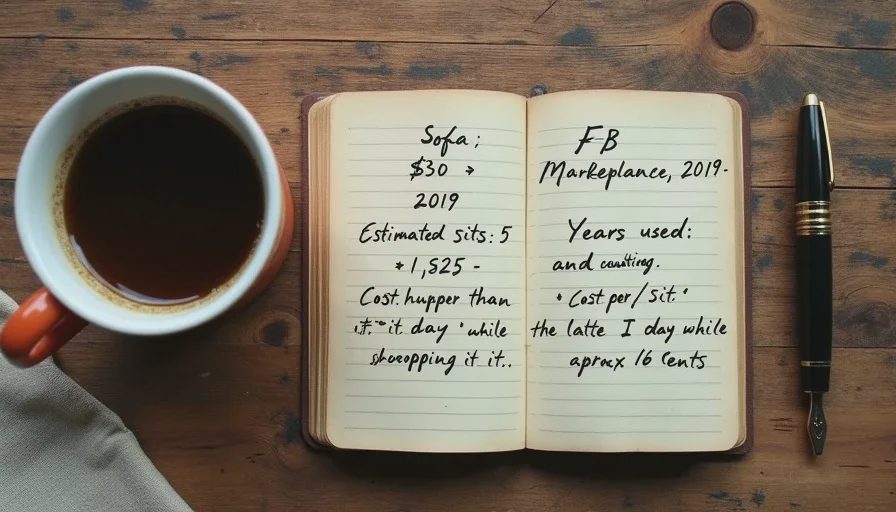
I bought a secondhand sofa five years ago from a family in Park Slope who were moving to California. It cost $300. It's a little saggy now, the fabric on the arms has worn thin, and one of the legs has a scratch from when Felix tried to "fix" it with a screwdriver. But this couch has survived twin toddlers, a cat who sharpens his claws on the left armrest, countless movie nights, and at least three stomach bugs. When I do the math — and I did do the math, because I'm the kind of person who finds comfort in spreadsheets — the numbers are almost embarrassing. Let's be conservative and say this sofa gets sat on once per day by one person (in reality, it's way more, but let's keep it simple). That's about 1,825 sits over five years. At $300, the cost per sit comes out to roughly sixteen cents. Sixteen cents. The latte I bought on my way to pick up the sofa cost more than that, and I don't even remember drinking it.

What "Investment Piece" Actually Does to Your Brain
Beyond the bad math, there's a psychological trap here. When you label something an "investment piece," you raise the stakes so high that making a choice becomes paralyzing. You can't just buy a sofa you like — you have to buy a sofa that represents your values, your taste, your long-term financial philosophy. So you spend six months scrolling, comparing, second-guessing. Meanwhile, your actual living room has nowhere to sit.
And here's the darker side: once you've dropped serious money on an "investment piece," you feel stuck with it. Even if it's uncomfortable. Even if the color looked different in the showroom. Even if you've never really liked it but you can't admit that because you told everyone it was an investment. I've been there. I once bought a "timeless" beige armchair from a mid-range retailer — not even expensive by investment-piece standards, maybe $600 — because a blog told me beige goes with everything. I hated that chair within a month. It showed every crumb, every cat hair, every shadow. I sold it two years later for $80 on Facebook Marketplace. That's not an investment. That's an 87% loss. I would have done better buying an actual stock and leaving the chair at the store.
What Actually Deserves Your Money
If you're going to stretch your budget on something, do it where it counts for daily comfort and long-term health: a mattress you sleep on every night, a desk chair if you work from home, decent kitchen knives if you cook. These are tools you use constantly, and quality directly affects your body. A sofa? Buy something you can afford without crying, and that you won't yell at someone for eating crackers on. Because the moment you treat a couch like a museum artifact, it stops being furniture and starts being a source of stress. And stress is the least stylish thing in any home.
The Real Value Lives in Stories, Not Resale Prices
My favorite piece of furniture is a battered oak dresser I hauled off a stoop in Clinton Hill for $40. It has water rings on top, a drawer that sticks unless you pull it at a specific angle, and a carved detail on the front that looks vaguely like a squirrel. The woman giving it away told me it belonged to her grandmother, who'd had it in her Brooklyn apartment since 1952. That dresser has survived three moves, two kids, and one incident involving a full fish tank. I love it more than anything I could buy new, not because it's valuable, but because it has a story. You can't order that from a catalog.
The Instagram Budget vs. Reality Budget
Part of what makes "investment piece" language so pervasive is that we're constantly shown homes where everything looks expensive. Decorating without sponsored products is rare online because the people showing you their living rooms are often being paid to show you those exact items. When an influencer calls a $3,500 sofa an "investment," remember that they might not have paid for it. You will.
In my home, which is a real apartment with realistic family home decorating happening whether I like it or not, the budget looks different. I keep a running log of every furniture purchase. The most expensive thing in our living room is the jute rug, which was $180 new. Everything else — sofa, coffee table, bookshelves, lamps, art — came secondhand or was made by someone in the family. The room looks good. Not catalog-good, not Instagram-good, but good in a way that feels like us. Friends come over and sit on the furniture without asking permission first. That's the metric that matters.
A Better Question to Ask Before You Buy
Instead of "Is this an investment piece?" try asking: "Will I enjoy using this every day for the next five years?" If the answer is yes, and you can afford it without sacrificing something more important, buy it. If you're using the word "investment" to justify a purchase that makes your stomach hurt when you look at your bank balance, step away. Good taste does not require debt. It does not require provenance. It does not require you to nod seriously while someone explains the difference between full-grain and top-grain leather.
Budget apartment decorating NYC style — which is to say, real-people decorating in one of the most expensive cities in the country — runs on creativity, not credit limits. Your home should make you feel comfortable and welcome. Not guilty. Not anxious. Not like you need to apologize for the sofa you could actually afford. Because at the end of the day, a couch is just a couch. And if it survives snack time, Saturday naps, and a cat who treats upholstery as a personal scratching post, it's doing its job beautifully.


Letters
No letters yet — be the first to write.