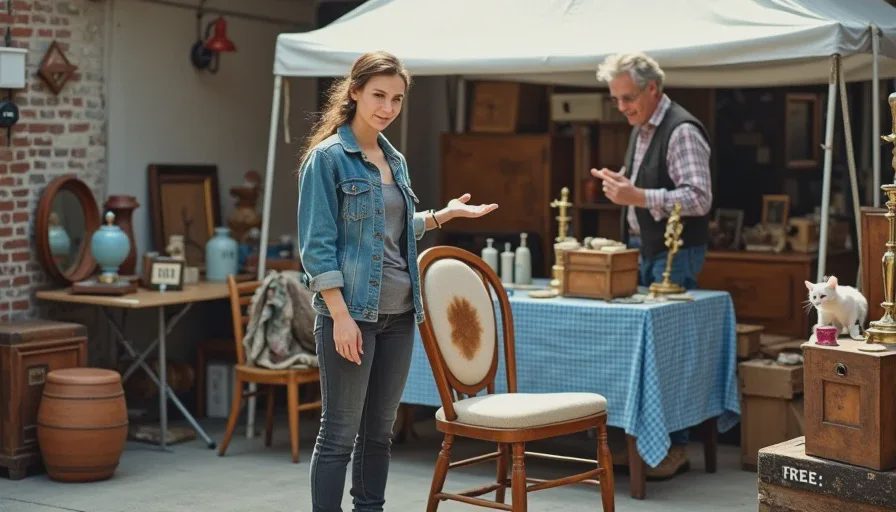
I have furnished four apartments almost entirely from secondhand sources. That's not a humblebrag — it's a survival strategy. When you're a freelance illustrator with an unpredictable income and a deep suspicion of anything sold in a showroom with recessed lighting and a scent diffuser, you learn to source things the old-fashioned way: stoop sales, flea markets, Facebook Marketplace, the occasional "free" pile that isn't hiding a nightmare. Over fourteen years, I've developed an internal hierarchy of what's worth the hunt and what you should leave on the curb, no matter how tempting the price tag. This is the secondhand furniture tips guide I wish someone had handed me when I moved into my first Brooklyn apartment with nothing but a futon and a lot of optimism. Here are the five things I will always, always buy secondhand — and the three I will never touch again.
Worth It #1: Solid Wood Furniture
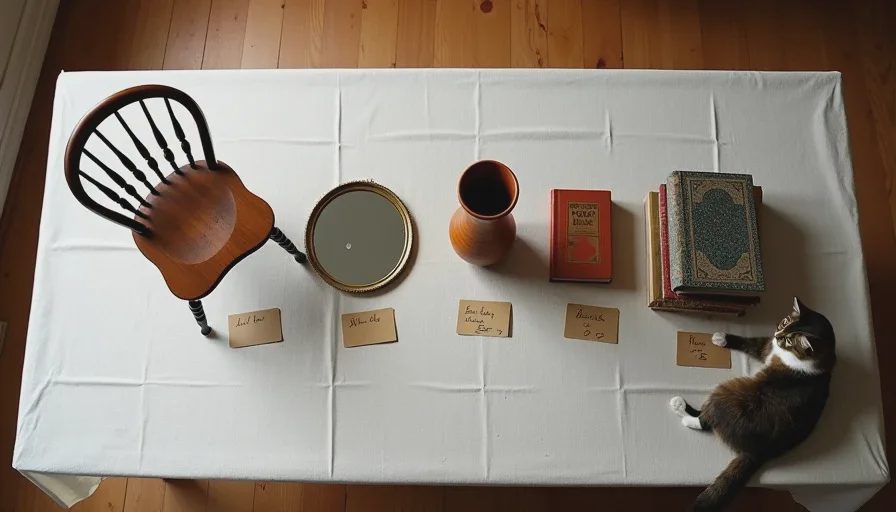
If you only remember one thing from this entire post, make it this: solid wood is always worth buying secondhand. Always. The reasons are so compelling that I've written about them in multiple posts, but let me consolidate the argument here. Solid wood furniture — dressers, tables, chairs, bookshelves, bed frames — was built in an era when furniture was expected to last generations. The joinery is better. The wood is thicker. The finish can be repaired, sanded, refinished, painted, or left alone to develop a patina that no factory can replicate. And because furniture depreciates the moment it leaves the showroom, you can buy a solid wood dresser from the 1940s for less than the cost of a new particle-board dresser from a big-box store that will disintegrate during your next move.
When you're assessing a solid wood piece, run through my checklist: knock on it (solid thud = real wood, hollow echo = veneer over particle board), check the joints (dovetails, mortise-and-tenon, dowels = quality; staples and glue = walk away), open and close every drawer (they should slide smoothly, not stick or wobble), and look for signs of active infestation (small holes with fine sawdust = woodworms, and you do not want woodworms in your apartment). If the piece passes all four tests and the price is reasonable — in Brooklyn, a solid wood dresser in good condition typically runs $40 to $150 on Facebook Marketplace — buy it. You will own it for the rest of your life. Felix once carved his name into the side of our oak dresser with a screwdriver. I sanded it out two years later. You can't do that with IKEA.
Worth It #2: Brass, Copper, and Solid Metal
Brass is having a moment — which means new brass items are expensive and often coated with lacquer that prevents them from developing the natural patina that makes brass beautiful in the first place. Old brass, on the other hand, is abundant at flea markets and thrift stores, and it costs a fraction of what new brass costs. I have found brass candlesticks for $5, brass picture frames for $8, brass drawer pulls for $2 each, a brass floor lamp for $25, and a brass tray that I use as a catch-all on my dresser for $10. None of them match in style or era, but they all match in material, and the variation in patina — some are bright, some are dark, some have green oxidation in the crevices — creates a collected-over-time look that you cannot fake with a trip to a home goods store.
The same logic applies to copper, solid aluminum, and cast iron. Old cast iron cookware, if it's not rusted through, is better than anything you can buy new. Old copper pots and pans — the kind with tin linings — are beautiful and functional and cost a tenth of what new copper costs. The key with metal is to check for structural integrity. Brass should be solid, not plated (plated brass will peel). Copper should be heavy, not thin. Cast iron should have no cracks. If it passes those tests and the price is under $30 for most small items, it's a good buy.
Worth It #3: Ceramics, Stoneware, and Pottery
I have a weakness for handmade ceramics, which is an expensive weakness if you buy them new. A single artisan mug can cost $40 to $60 at a craft fair or a boutique. At a thrift store, that same mug — made by someone equally talented, perhaps decades ago — costs $3 to $8. I have built an entire kitchen collection of mismatched ceramic mugs, bowls, plates, and vases, none of which cost more than $10 and all of which are handmade, one-of-a-kind, and more beautiful than anything I could find in a store.
When buying secondhand ceramics, check for cracks. A hairline crack might be fine for a vase that only holds dried flowers, but it will eventually fail if the piece holds water or food. Run your finger along the rim of mugs and bowls — chips are common and sometimes you can live with them, sometimes you can't. Look at the bottom for a maker's mark or a studio stamp; these don't increase the monetary value necessarily, but they connect the piece to a real person who made it, which is the whole point of buying handmade things. The $8 bowl that inspired my kitchen color palette — the one with the mustard-to-rust glaze — has a small crack near the base. It doesn't hold soup, but it holds fruit, and it sits on my kitchen counter making me happy every time I see it.
Worth It #4: Vintage Wool Rugs
I've written about my $80 vintage rug before, but it deserves repeating here because vintage rugs are the single best deal in all of secondhand home decor. A new hand-knotted wool rug in a traditional Persian or Turkish pattern costs $800 to $3,000 depending on size, quality, and provenance. A used one — same wool, same hand-knotting, same natural dyes, but with some fading, some wear, maybe a small stain — costs $50 to $200 in a secondhand shop or on Facebook Marketplace. The wear is the point. A vintage rug has already proven it can survive decades of foot traffic. The colors have mellowed. The patterns have softened. The rug has become, in a very real sense, better with age.
When you're shopping for a vintage rug, you don't need to be an expert in knots per square inch or tribal provenance. You need to check three things: smell (if it smells like mildew, walk away — that smell is almost impossible to remove completely), structural integrity (hold it up to the light — if you can see through it in large patches, the foundation is worn and the rug is near the end of its life), and color (fading is fine, but large bleached-out spots or significant color bleeding means the rug was cleaned improperly at some point). If it passes those tests and the price is under $200 for a room-sized rug, it's a good buy. My $80 rug has a wine stain near one edge. The seller was upfront about it. It's under the coffee table now, and no one has ever noticed except me, and I only notice when I'm vacuuming.
Worth It #5: Old Books
This is a small category compared to the others, but it's one of my favorites. Old hardcover books — the kind with cloth-covered boards and sewn bindings, printed before the era of perfect-bound paperbacks — cost $2 to $5 at library sales, thrift stores, and flea markets. They're beautiful as objects: the faded colors of the cloth, the gold or silver stamping on the spine, the weight of the paper, the smell of old ink and time. I use them as risers for lamps and vases, as stacks on the coffee table, as color accents on bookshelves. A row of vintage books in muted greens, blues, and reds is one of the cheapest and most effective decorating tools I know.
You don't need to read them — though you might, and that's a bonus. You're buying them for their spines, their colors, their presence as objects that have survived decades and still have something to offer. Check for mold (black or brown spots, musty smell — don't bring moldy books into your home) and loose bindings (a little looseness is fine, but pages falling out means the book is past the point of decorative usefulness). And don't buy books just because they're old and cheap. Buy books in colors you actually want to look at. A stack of mustard-yellow and forest-green vintage novels on a nightstand is a design choice. A stack of beige textbooks from the 1970s is just clutter.
Not Worth It #1: Upholstered Furniture from Strangers
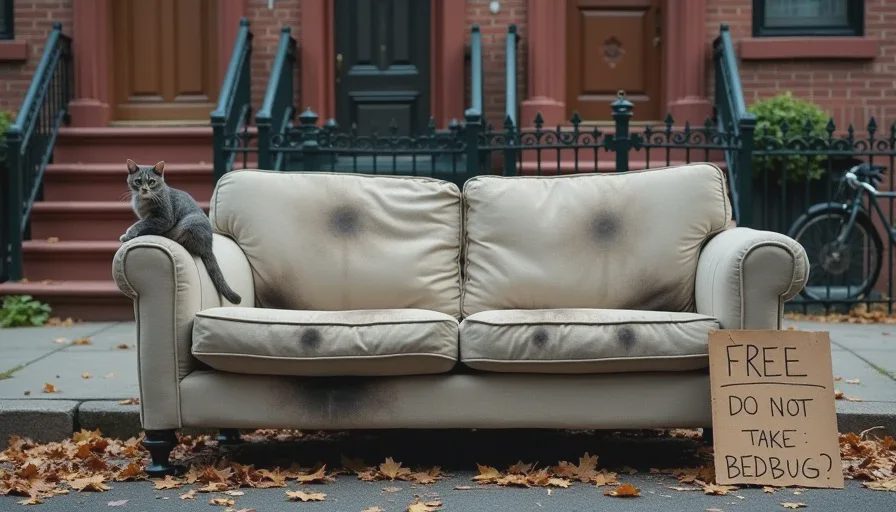
https://free-couch-curb-brooklyn-bedbug-warning.jpg
I need to say this as clearly as possible: do not take upholstered furniture from the curb. Do not take upholstered furniture from strangers on the internet unless you are willing to inspect it with the intensity of a crime scene investigator and accept the residual risk that you might miss something. I know people — multiple people, in Brooklyn — who have brought home a "free" couch or armchair and ended up spending thousands of dollars on bedbug remediation. One friend, a fellow illustrator in Greenpoint, picked up a velvet armchair from a stoop in Park Slope. It was beautiful. It was free. It was also harboring a bedbug colony that took her six months, three exterminator visits, and approximately $3,000 to eliminate. She had to throw out her own mattress, her own sofa, and half her clothing. The free armchair cost her three thousand dollars and six months of psychological distress.
I'm not saying you should never buy secondhand upholstery. I bought my $75 sofa secondhand, and I've written extensively about how to do it safely. But I inspected every seam with a flashlight. I quarantined it for twenty-four hours before letting anyone sit on it. I checked the underside, the crevices, the zipper areas. And I bought it from a family who was moving and had visibly clean, well-maintained furniture in the rest of their apartment. I didn't drag it off a curb at midnight. If you're going to buy secondhand upholstery, buy from someone whose home you can see — either in person or through detailed photos. If the listing says "free" and the photo is taken on a sidewalk, keep walking.
Not Worth It #2: Mattresses
This one is non-negotiable. Do not buy a used mattress. Do not accept a free mattress from a friend, a neighbor, or a well-meaning relative who is "upgrading." Mattresses absorb everything — sweat, skin cells, dust mites, allergens, and in worst-case scenarios, bedbugs. You cannot see what's inside a mattress. You cannot clean what's inside a mattress. A mattress is the one piece of furniture that directly touches your body for eight hours a day, every day, and the risk of bringing someone else's biology into your sleep environment is not worth the money you'd save.
If you're on a tight budget — and I'm always on a tight budget — there are ways to get a new mattress without spending a fortune. Direct-to-consumer mattress companies have driven prices down significantly. A decent foam mattress in a box can cost as little as $200 to $400 new. Some retailers sell floor models or returns at a discount. But do not buy a used mattress from a stranger. If you absolutely must accept a used mattress from someone you know extremely well — like, you've seen their bedroom, you know their hygiene habits, you'd trust them with your pet — then use a mattress encasement that zips completely around the mattress and traps anything that might be inside. But honestly, just save up and buy a new one. Your sleep is worth it.
Not Worth It #3: Mystery Electronics and Vintage Lamps (Unless You Know What You're Doing)
I love a vintage lamp. I own several. But vintage lamps come with vintage wiring, and vintage wiring can be dangerous. The insulation on old electrical cords degrades over time, becoming brittle and cracked. The sockets can be loose or corroded. The wiring inside the lamp body might be held together with cloth tape from the 1950s. If you don't know how to rewire a lamp — or you're not willing to pay someone who does — don't buy a vintage lamp that hasn't been professionally rewired.
The same logic applies to any electrical item. Vintage fans, old radios, retro toasters — they're charming as decorative objects, but if you plug them in without checking the wiring, you're risking a short circuit, an electrical fire, or worse. I have a beautiful old brass floor lamp in my living room that I bought for $25 at the Brooklyn Flea. Before I plugged it in, I paid an electrician $60 to replace the cord, the socket, and the internal wiring. The total cost was $85, which is still less than a new floor lamp of similar quality. But the key is that I factored in the rewiring cost before I bought it. If a vintage lamp costs $25 and rewiring costs $60, that's an $85 lamp. If you're not willing to spend the total, don't buy the lamp.
The Bottom Line
Secondhand shopping is the single best way to furnish a home with character, quality, and history without spending a fortune. But it requires discernment. The thrill of the find is real — the rush of spotting a solid oak dresser for $40, the satisfaction of negotiating a fair price, the pleasure of living with something that's older than you are and will outlast whatever particle-board furniture the big-box stores are selling this season. But the thrill should never override your common sense. Before you hand over cash at a flea market or message a seller on Facebook Marketplace, ask yourself: can this item be thoroughly cleaned? Does it have a history I can verify or at least reasonably trust? Is the risk of hidden damage or infestation worth the savings? For solid wood, the answer is almost always yes. For upholstery from a curb, the answer is almost always no. Happy hunting. Bring a flashlight.



Letters
No letters yet — be the first to write.