
I have been waking up too early on Saturdays to dig through other people’s discarded furniture for over a decade. Fort Greene flea, the Brooklyn Flea, the occasional stoop sale that spills onto a Clinton Hill sidewalk — I’ve done them all. Along the way, I’ve hauled home some genuine treasures and a truly embarrassing amount of garbage. The worst was a “mid-century” side table that turned out to be laminate over particle board. It disintegrated during an especially humid August, leaving a pile of sawdust and regret in my hallway. That table taught me more about secondhand furniture tips than any blog ever did. These six rules are the result of every mistake I’ve made — so you don’t have to make them yourself.
Rule #1: Knock on Everything Like You're the Building Inspector
If you learn one thing from this post, make it the knock test. Solid wood sounds solid — a dull, resonant thud, like knocking on a door. Veneer over particle board sounds hollow and thin, like tapping on a cardboard box. I knock on table tops, chair legs, dresser sides, even picture frames. The sellers might look at you like you're auditioning for a home renovation show, but they're not the ones who have to carry the thing up three flights of Brooklyn stairs.
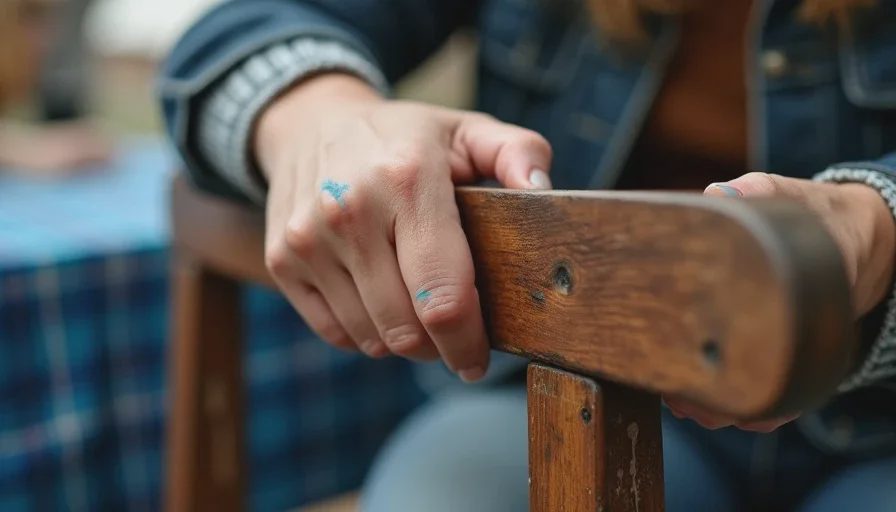
Once you've established it's real wood, check the joints. Look for dovetailing on drawer corners, mortise-and-tenon on chairs, dowels or screws — anything that indicates someone took the time to build it properly. If you see staples or glue gun residue, walk away. That piece was designed to last through one apartment lease, not a lifetime. I once found a solid oak nightstand at the Fort Greene flea with hand-cut dovetails. The seller wanted $45. I still have it. Marcus uses it as his bedside table, and it's survived two moves without wobbling.
Rule #2: Smell It Before You Buy It
This sounds obvious, but enthusiasm has a way of overriding basic senses. Upholstered furniture can harbor odors that will not come out — cigarette smoke, mildew, the ghost of someone's expired cat. If a fabric piece smells even slightly off in the open air of a market, it will smell ten times worse inside your apartment. I learned this the hard way with a velvet ottoman that seemed fine outdoors but released an aroma of damp basement the moment it warmed up in our living room. Gouache refused to go near it, and Gouache sits on everything. That ottoman lived on the curb within a week.
Solid wood pieces are generally safer, but still check inside drawers and cabinets. A musty smell there usually means the piece was stored somewhere damp, and you might be dealing with mildew that needs serious cleaning. I've had success airing out mildly musty dressers by leaving them on our fire escape on a dry, sunny day and wiping every surface with diluted white vinegar. But if the smell is strong, save yourself the trouble.
Rule #3: Bring Cash, Arrive Early, and Don't Be Afraid to Bundle
Cash is still king at flea markets. Many vendors don't take cards, and even if they do, cash gives you a psychological edge. When you hold up actual bills and say, "Would you take $40 for this?" it lands differently than swiping a credit card. Arrive early for the best selection — I aim for the first hour the market opens, when the light is good and the good stuff hasn't been picked over yet. But the flip side is that end-of-day bargaining can work in your favor, especially with larger furniture that a vendor doesn't want to haul back home.
Bundling is my favorite tactic. If a seller has a dresser I want and also a box of brass hardware or a small mirror I've had my eye on, I'll offer one price for both. "Would you do $65 for the dresser and the mirror?" Most sellers are happy to move multiple items at once. The worst they can say is no, and even then, you can usually negotiate down on the single item afterward.
Rule #4: Have a Measuring Tape and Know Your Dimensions
The number of times I've watched someone at a flea market hold their arms out to approximate the width of a bookshelf is too high to count. Do not be that person. I keep a small retractable measuring tape in my market bag at all times, right next to my wallet and a folded tote for smaller finds. Before you even leave your apartment, measure the space where you're hoping to put something. Write those numbers on your phone or a scrap of paper. Include ceiling height if you're shopping for tall pieces, and door width if you live in a pre-war building with narrow hallways — which, in Brooklyn, you probably do.
I once found a perfect 1940s armoire at the Brooklyn Flea for $120. Solid oak, beautiful patina, original brass handles. I measured it twice at the stall. It fit the wall. What I didn't measure was our building's stairwell turn. Marcus and I spent forty-five minutes wedged on the second-floor landing with an armoire that would not pivot. We had to remove the door, remove the hinges, and in the process gouged a chunk out of the plaster wall. The armoire did eventually make it upstairs. Marcus still mentions it at dinner parties.
Rule #5: Know What's Worth Buying Secondhand — and What's Not
After years of trial and error, here's my honest hierarchy:
Worth it, almost always: Solid wood furniture (dressers, tables, bookshelves, chairs), picture frames with real glass, brass and copper accessories, ceramic and stoneware vases, vintage mirrors with solid backing, old tools, cast iron cookware, real linen textiles in good condition.
Proceed with extreme caution: Upholstered furniture (smell it, check for bedbug signs, factor in reupholstery costs), mattresses (just don't), electrical items like lamps (the wiring might be unsafe — unless you're willing to rewire or know someone who can), anything with chipped paint that might contain lead (test kits exist and they're cheap).
Usually not worth it: Laminate furniture from big-box stores that's being resold at near-retail prices, mystery electronics, "vintage" plastic anything that's just old Tupperware, most particle-board shelving units that are already sagging.
Rule #6: The Best Finds Come When You're Not Looking for Anything Specific
This is the rule that defies all planning, but it's the truest thing I know about Brooklyn flea market home finds. Every time I've gone to a market with a laser-focused list — "I need a coffee table, exactly 42 inches long, with a lower shelf" — I've come home empty-handed and annoyed. The best pieces I own appeared when I was wandering aimlessly with a coffee in one hand and no expectations. The $75 sofa? I was on my way to buy vegetables at the farmers market and walked past a stoop sale. The vintage quilt that built my living room color palette? I spotted it folded under a pile of old curtains at a stall I almost skipped.
There's a kind of openness required for vintage furniture sourcing. You're not shopping from a catalog where every item exists in eight finishes. You're sifting through other people's histories, and the thing that works in your space might not be the thing you pictured. Stay flexible, trust your instincts, and if something makes you smile immediately, grab it before someone else does. Hesitation is the enemy of a good flea market score.

https://brooklyn-flea-market-haul-mirror-vase-candlesticks.jpg
One Last Thing: Don't Be a Jerk
Flea market vendors are people, not retailers. They've often dragged this furniture out of storage, cleaned it up, and hauled it to the market before sunrise. Don't lowball to the point of insult — offering $5 for a $50 dresser isn't negotiating, it's being rude. I usually start at about 20-25% below asking price if I think the item is reasonably priced, and I'm prepared to pay full price if the seller won't budge. If you love something and the price is fair, just pay it. The thrift store home decor ideas that make a real difference in your home are rarely the ones you haggled down to nothing. They're the ones you were excited to carry home.



Letters
No letters yet — be the first to write.