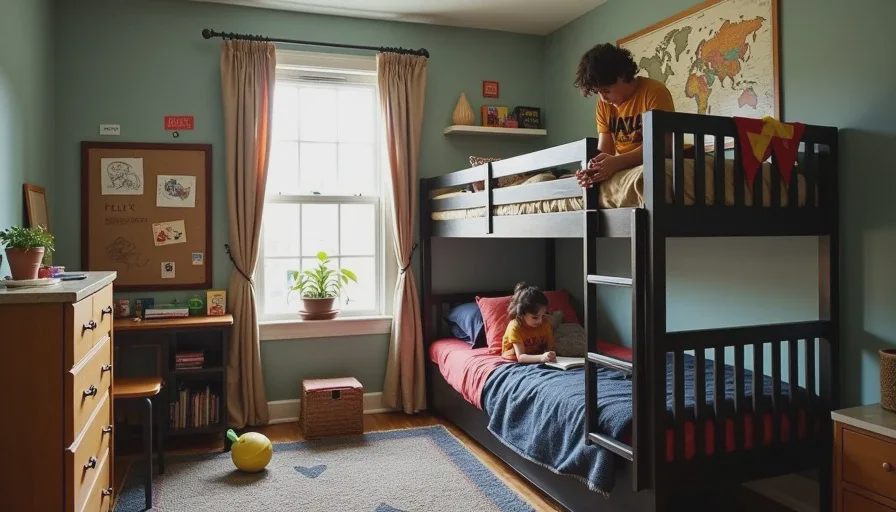
I have walked past my twins' bedroom door approximately six thousand times since we moved into this apartment. For the first two years, every time I walked past, I flinched. Not because the room was ugly — it was fine, it was a kid's room, kids' rooms are supposed to be chaotic — but because it felt like a space that was happening to us rather than a space we had made. The walls were landlord beige. The storage was a collection of plastic bins that multiplied like gremlins. The art on the walls was whatever poster came with the last birthday party gift bag. It was a room that said "children sleep here" and nothing else.
I knew I could do better. But every time I looked for decorating kid rooms inspiration, I fell into one of two traps. Trap one: the Instagram nursery — soft pastels, a $400 felt animal head mounted on the wall, a teepee in the corner that no child has ever actually played in, everything "curated" within an inch of its life. Trap two: the hyper-themed room — dinosaurs everywhere, or unicorns everywhere, or outer space everywhere, as if a child is a brand and their room is the flagship store. Neither of these felt like a room where real children — my children, Felix and Cleo, who are eight and have strong opinions about everything — would actually want to spend time.
So I developed a third way. A room that works for kids — their stuff, their chaos, their evolving tastes — while also being a room adults can walk past without their souls leaving their bodies. This is the twin kids room decor ideas post I wish I'd found five years ago, built on eight years of trial, error, and the slow realization that the best kid rooms aren't designed for children. They're designed with children.
The Principle: This Room Belongs to Them, But You Have to Live With It Too
Before I get into specific storage systems and wall colors, I want to name the tension at the heart of every kid-room project. On one side: this is your child's space, and their taste matters. They should have a say in what their room looks like. On the other side: you are the adult who pays for the furniture, cleans the floors, and has to walk past that door multiple times a day. Your sanity also matters. A good kid room balances both — it takes the child's preferences seriously without turning the room into a theme park, and it incorporates adult-level practicality without turning the room into a beige box that could belong to anyone.
With Felix and Cleo, I sat down and asked them what they wanted. Felix said "a spaceship." Cleo said "a cat museum." I translated this as: Felix wants a sense of adventure and discovery, Cleo wants to display things she loves. Neither of those requires me to paint a mural of the solar system or install display cases. The world map on the wall — thrifted, $5, from an old National Geographic — gave Felix his sense of exploration. The cork board above the desk — $8 at a flea market — gave Cleo her gallery. Both things can be changed when their interests change, which at age eight happens approximately every six weeks.
The Color: Something That Hides Fingerprints
Let's start with the walls, because wall color sets the tone for everything else. Kid-room wall color advice tends to fall into two camps: "paint it bright and stimulating" and "paint it neutral so it can grow with them." I reject both. Bright colors are overstimulating in a room where kids are supposed to sleep, and neutral colors in a kid's room just means you've given up and are waiting for them to move out. There is a middle ground: a color that has personality, hides the inevitable fingerprints, and doesn't feel like a nursery.
The twins' room is painted a warm, dusty grey-green — not sage, not mint, but something closer to the color of old library walls or the inside of a vintage pencil case. It's calm enough to sleep in, interesting enough to feel intentional, and dark enough to hide the fingerprints that accumulate at light-switch height. When Cleo drags her hand along the wall walking to her bed — a habit I've mentioned before — it leaves no visible trace. When Felix sticks washi tape to the wall to "mark his territory" — a phase we're still in — it peels off without taking the paint with it, because I used an eggshell finish that can handle a little abuse.
If you're painting a kid's room, skip the flat finish. Flat paint is impossible to clean, and kids generate things that need to be cleaned off walls — marker, juice, the contents of a sneeze, substances I cannot identify. Go for eggshell or satin. Skip the bright primary colors unless your child specifically and repeatedly requests them, and even then, consider using them as accents rather than all-over wall color. A bright yellow wall is cheerful for about a week, and then it's just loud at 6 a.m. when you're trying to determine if that noise was a child falling out of bed or just a book hitting the floor.
The Storage: Old Furniture Beats Plastic Bins Every Time
The single best decision I made in the twins' room was to stop buying plastic storage bins and start buying old wooden furniture instead. I realize this sounds like the kind of advice someone gives when they've never actually met a child, but hear me out. Plastic bins are cheap, yes. They're lightweight, they come in colors, they stack. But they also crack, they collect dust in their textured surfaces, the lids disappear into a parallel dimension, and they look terrible no matter how you arrange them. After three years of replacing cracked bins and never being able to find the lid that matched the bin that matched the shelf, I gave up.
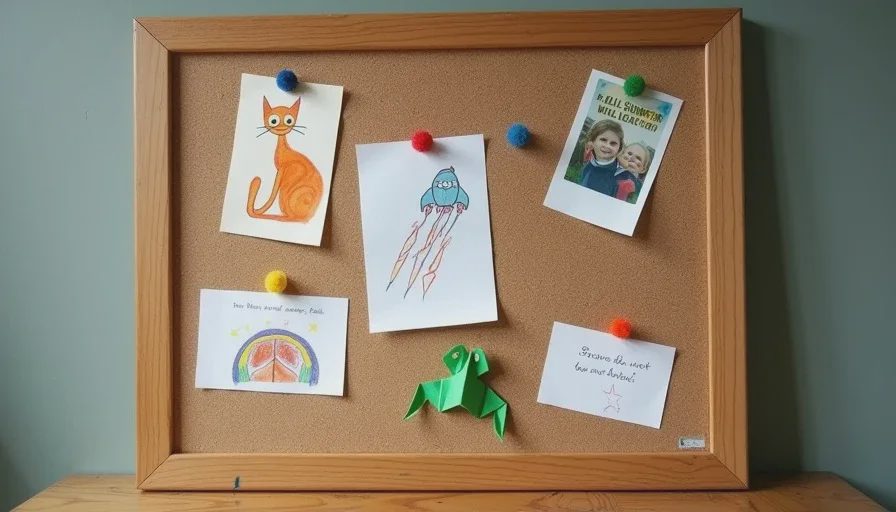
I found two old wooden dressers on Facebook Marketplace — one was $40, the other was $50. They don't match. One is dark oak with mismatched brass pulls, the other is lighter pine with chipped paint. But they're solid wood, they have drawers that actually open and close, and they hold an astonishing amount of kid stuff. Each child gets one dresser. Felix's holds his clothes, his rock collection, his comic books, his soccer cards, and approximately seven thousand Lego pieces that are "part of an ongoing project." Cleo's holds her clothes, her sketchbooks, her bead collection, her rock collection (they both have rock collections, they're competitive about it), and the stuffed animals that don't fit on her bed.
The top of the dressers doubles as display space — something no plastic bin can offer. The kids arrange their treasures up there: seashells from a beach trip, a wooden robot Felix made in shop class (it's missing a hand, which makes me love it more), a glass jar of interesting sticks, a plastic dinosaur guarding a small succulent. It's not curated. It's chaotic. But it's their chaos, contained on a surface that looks intentional because the dressers themselves are beautiful old pieces of furniture.
The second storage win was the low bookshelf. I found a short, wide wooden bookshelf at a stoop sale for $15. It sits against the wall under the window, and it holds picture books, chapter books, a basket of markers, a basket of Legos, and a basket of "things I found outside that I'm not ready to throw away." The baskets are woven — thrifted, $3 to $5 each — and they hide the visual noise of small objects without requiring kids to operate a lid. A basket with no lid is the most kid-friendly storage solution ever invented. They can see what's inside. They can toss things in from across the room. They can — and do — dump the entire basket out when they're looking for one specific Lego piece. And when it's time to clean up, everything goes back in the basket. No lids to lose, no drawers to jam, no system to maintain.
The Art Display: Let the Room Change
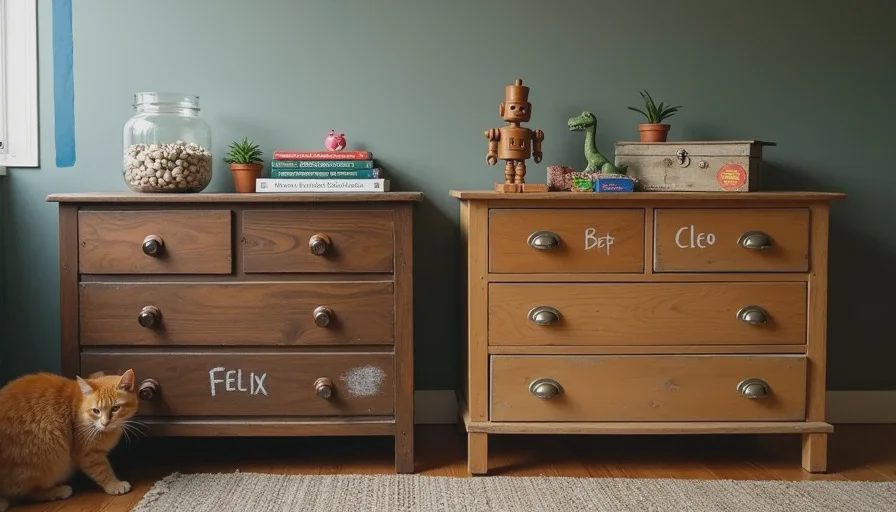
The cork board above Cleo's desk is the most functional thing in the room. It cost $8 at a flea market — a plain pine frame with a slightly stained cork surface — and it has become the room's creative nerve center. Every few weeks, the kids rotate what's on it. Old drawings come down, new ones go up. There's a watercolor of Gouache that Cleo painted when she was six, a pencil drawing of a rocket ship that Felix spent three days on, a leaf rubbing from a second-grade science project, two library summer reading certificates, a Polaroid of both kids at the playground, and a sticky note that says "FELIX DO NOT TOUCH MY MARKERS" in Cleo's increasingly forceful handwriting.
The cork board works because it's flexible. When Felix went through a phase where all he wanted to draw was volcanoes, the board filled up with volcanoes. When Cleo decided she was going to illustrate an entire graphic novel about a detective cat, the board became her storyboard. The board changes as they change, and because the frame is a nice old pine and the wall behind it is a calm grey-green, the chaos reads as intentional. It's a gallery, not a mess. That's the visual trick at the heart of realistic family home decorating: give the chaos a frame, and it becomes a collection.
I also hung a large world map on the other wall — an old National Geographic pull-out that I found at a thrift store for $5 and had mounted on a simple wooden frame. Felix is obsessed with it. He puts colored pushpins on places he's read about in books. Cleo puts pushpins on places she wants to visit. There's currently a pin on Madagascar because they watched a documentary about lemurs, and a pin on Tokyo because Felix read a book about bullet trains. The map cost almost nothing and it has become the most-used object in the room. It's educational, it's decorative, and it will still be relevant when they're teenagers and planning their own trips.
The Beds: Go Neutral, Go Flexible
When the twins graduated from their toddler beds — which was a whole ordeal involving Felix refusing to sleep in anything that wasn't his "baby bed" for three weeks — we had to make a decision about what came next. Two twin beds? Bunk beds? Two beds in different parts of the room? I chose a wooden bunk bed, but not the kind made of painted metal tubing that looks like it belongs in a summer camp. A solid wood bunk bed with a natural finish — no paint, no theme, just wood. It can be bunked or un-bunked into two separate twin beds if they ever want their own rooms. The wood has aged beautifully, picking up dings and scratches that only make it look better.
The bedding is simple and mix-and-match. White cotton sheets — bought new, because sheets are the one thing I don't thrift — and blankets that are a mix of vintage and homemade. Cleo has a faded coral-pink quilt that I found at a thrift store for $20. Felix has an old navy wool blanket with a visible patch on one corner — a hole he burned with a magnifying glass during a "science experiment," which I repaired with red and yellow thread. The pillows are covered in pillowcases made from old linen napkins and vintage cotton. Nothing matches, but everything works together because the color palette — deep blue, coral, mustard, cream — is pulled from the same vintage quilt that inspired the living room. The rooms in our apartment don't match, but they rhyme.
The No-Theme Theme
I need to say something about themed rooms, because the themed room is the siren song of kid-room decorating. It's so tempting. Your child loves dinosaurs, so you paint a dinosaur mural and buy dinosaur sheets and a dinosaur lamp and dinosaur curtains, and for about three months your child is ecstatic and you feel like a parenting genius. And then your child discovers space, or superheroes, or deep-sea creatures, and you're stuck with a room full of dinosaurs that your child has emotionally outgrown but you have financially invested in. I have watched this happen to at least four different families. The dinosaur phase lasted six months. The dinosaur bedding lasted three years.
Instead of a theme, I gave the room a palette and a system. The palette — grey-green walls, natural wood, pops of mustard, coral, and deep blue — can absorb any interest. When Felix was in his volcano phase, the red and orange drawings looked great against the grey-green walls. When Cleo was in her rainbow phase, the rainbow art popped against the neutral wood. The room doesn't fight their interests. It frames them. The system — dressers, baskets, cork board, map — can hold any collection. Rocks, shells, comic books, art supplies, whatever comes next. When their interests change, the stuff changes. The room stays the same.
What I'd Do Differently
If I were starting over from scratch, I'd buy the old dressers sooner. I wasted three years on plastic bins that cracked and systems that didn't work before I finally invested in real furniture that can hold a decade's worth of evolving kid stuff. I'd also paint the room sooner. The beige years were a drain on my spirits every time I walked past the door, and the kids didn't care about the beige — they just didn't notice it. Kids don't notice beige. They notice a cork board full of their own drawings, a map with pushpins, a dresser top covered in their own treasures. The room should be a backdrop for their lives, not a statement about your design sensibility.
Home decor for families with kids is not about creating a room that looks good on Instagram. It's about creating a room where your children feel ownership — where their stuff has a place, their art has a wall, their current obsession has a surface to land on. It's also about creating a room you can walk past at 9 p.m. when they're finally asleep, glance in, and feel something other than the urge to close the door and pretend it doesn't exist. The best kid rooms are the ones that feel like the kids who live there. And the kids who live there are weird and wonderful and constantly changing, just like their cork boards. Let the room change with them. That's the design.


Letters
No letters yet — be the first to write.