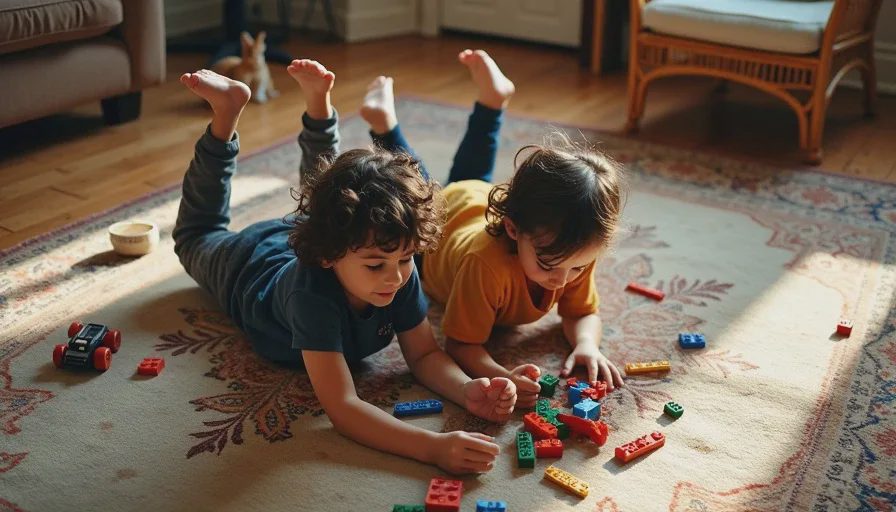
When Felix and Cleo were born — both at once, in a dramatic entrance that still gets brought up at family gatherings — I had a lot of ideas about how our home would look. I'd been decorating apartments for years. I knew my way around a flea market. I had a color palette. I was, in retrospect, embarrassingly confident. Then the twins learned to crawl, and everything I thought I knew about home decor for families with kids collapsed under the weight of two tiny humans who treated furniture like an obstacle course designed specifically to test my sanity. They're eight now. The crawling phase is long behind us, replaced by indoor scooter routes, fort-building operations that consume entire rooms, and an ongoing philosophical debate about whether the hallway is a running lane (Felix says yes, Cleo says only before dinner). Here's what survived. Here's what didn't. And here's what I wish someone had told me before I wasted money on anything that couldn't be wiped down with a Clorox wipe at 3 a.m.
The Graveyard: What Didn't Make It
Let's start with the casualties, because the list is longer than I'd like to admit and honesty is the whole point of this blog.
The Velvet Armchair (RIP, Year 2)
I bought a forest-green velvet armchair when the twins were about eighteen months old. It was beautiful. It was soft. It was, according to the salesperson, "surprisingly durable." Within six months, it had been baptized in grape juice, apple sauce, and something I never identified but chose not to think about. The velvet — which I later learned was cotton velvet, not the more forgiving synthetic kind — held every stain like a grudge. I tried vinegar, baking soda, a rented steam cleaner, and finally just accepted that the chair would always look like evidence from a crime scene. It went to the curb during a spring cleaning purge, and the woman who picked it up looked genuinely thrilled. I hope she didn't have kids.
The Glass Coffee Table (RIP, Year 1)
This one is entirely on me. I owned a glass coffee table before the twins were born, and I thought, "I'll just teach them not to touch it." If you have ever thought this sentence about a toddler, please understand that you are wrong. Felix took his first wobbly steps toward that table at ten months, grabbed the edge to steady himself, and the whole thing tipped. The glass didn't shatter — it was tempered — but watching a one-year-old nearly bring a forty-pound pane of glass down on himself was enough to permanently alter my furniture philosophy. The table was on Facebook Marketplace within the hour. I replaced it with a round wooden coffee table with no sharp corners, and that table has survived every collision since.
The White Linen Curtains (RIP, Year 3)
White linen curtains in a home with children are an act of hubris. They looked gorgeous for approximately four months. Then came the marker incident. Then the spaghetti incident. Then the incident where Gouache decided the hem was a toy and shredded the bottom six inches of both panels. I now have cotton curtains in a warm oat color that hide everything and can survive a wash cycle without coming out looking like crumpled tissues. If you're doing realistic family home decorating, your curtains should be machine-washable and the color of things that happen in real life.
The Survivors: What Actually Worked
Now for the good news. Some things have genuinely held up, and I recommend them with the confidence of someone who has watched them endure eight years of twin chaos.
The Jute Rug (Still Going Strong, Year 4)
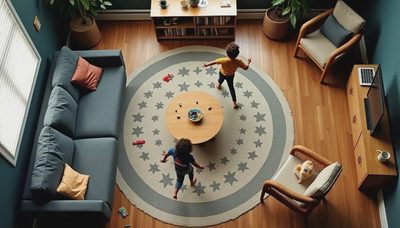
I was skeptical about a natural fiber rug with kids. Jute is rough underfoot, it sheds at first, and the internet told me it would stain if you looked at it wrong. But four years in, this rug has absorbed spilled milk, stomach bugs, indoor rain from a tipped-over plant pot, and countless muddy footprints from the fire escape. The trick is that jute is already the color of dirt. It's a warm, earthy brown-tan that doesn't show stains so much as incorporate them. I vacuum it weekly, spot-clean with a damp cloth when something truly offensive happens, and about once a year I haul it outside and beat it like it owes me money. It's not soft. The kids don't care. They sit on it, build on it, and occasionally nap on it when they've exhausted themselves running laps around the apartment. If you want a rug that makes your space look "elevated" — sorry, I said I wouldn't use that word — then jute isn't it. If you want a rug that survives, this is it.
Performance Fabrics That Actually Perform
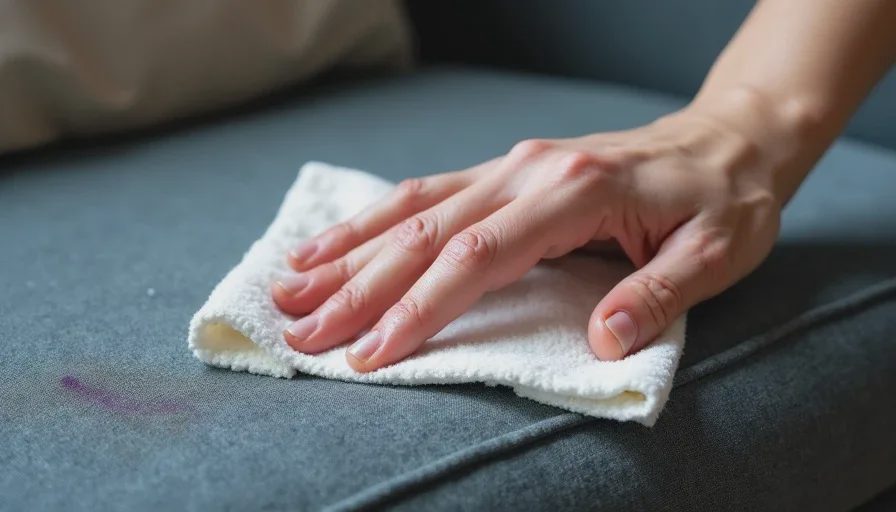
I'm going to say something that sounds like I'm being paid to say it, but I promise I'm not: Crypton and Sunbrella fabrics are worth the money. Our current sofa — the famous $75 one — came with a worn-out cotton cover that I replaced with a Crypton blend in deep gray-blue. Crypton is a moisture-barrier fabric originally designed for hospitals and restaurants. It's basically armor disguised as upholstery. Grape juice beads up on it. Milk wipes off with a paper towel. The cat's claws have done minimal damage because the weave is tight enough that there's nothing to snag. It's not cheap — recovering our three-seater cost about $400 — but that's still less than buying a new sofa, and I haven't had to scrub anything out of it at 3 a.m. in three years.
Solid Wood Everything
I've said it before and I'll keep saying it: solid wood is worth the hunt. Particle board swells when it gets wet. Veneer peels when the humidity changes. But a solid oak dresser or a maple tabletop — those things can be sanded down and refinished when they get too many scratches. Felix once carved his name into the side of our oak dresser with a screwdriver. He was four. He was "fixing" it. I sanded the scratch out two years later and you can't even tell. Try that with an IKEA dresser and you'll sand straight through to the cardboard core.
Rounded Corners and Soft Edges
After the glass table incident, I became evangelical about furniture with no sharp corners. Our coffee table is round. Our dining table has rounded edges. The bookshelves are anchored to the wall — always anchor your bookshelves — and the lower shelves hold board books and baskets of toys, not breakable things. This isn't just safety; it's a kid-proof home layout strategy that makes the whole apartment feel less like a booby-trapped obstacle course. When the kids have friends over, I don't spend the whole time flinching.
The Color Trick That Hides Everything
I mentioned this in my beige essay, but it bears repeating with a kid-specific angle. Darker, more saturated wall colors hide fingerprints. Beige walls show every single handprint, every smudge, every crayon mark. Our deep blue-green hallway — the one that replaced the ill-fated chartreuse accident — has survived eight years of sticky fingers and looks better than the beige ever did. When Cleo dragged her hand along the wall while walking down the hallway (a habit she's had since age two), it left nothing visible. If you're decorating with kids, paint color guide for rooms advice should include this: satin or eggshell finish in a mid-to-dark tone. Flat paint is impossible to clean. High-gloss shows every imperfection. Satin is the sweet spot.
The Layout That Prevents 80% of Chaos
This is a preview of a full post I'll write later, but the short version is this: clear pathways matter more than anything else. When the twins were toddlers, I rearranged the living room so there was a clear loop — from the sofa around the coffee table past the bookshelf and back. They could run that loop without crashing into anything, and they did, endlessly. When they got older, the same layout meant they could chase each other or the cat without toppling a lamp. Keep the center of the room open, push furniture against walls if you can, and for the love of everything, bolt tall furniture to studs.
What I'd Tell My Past Self
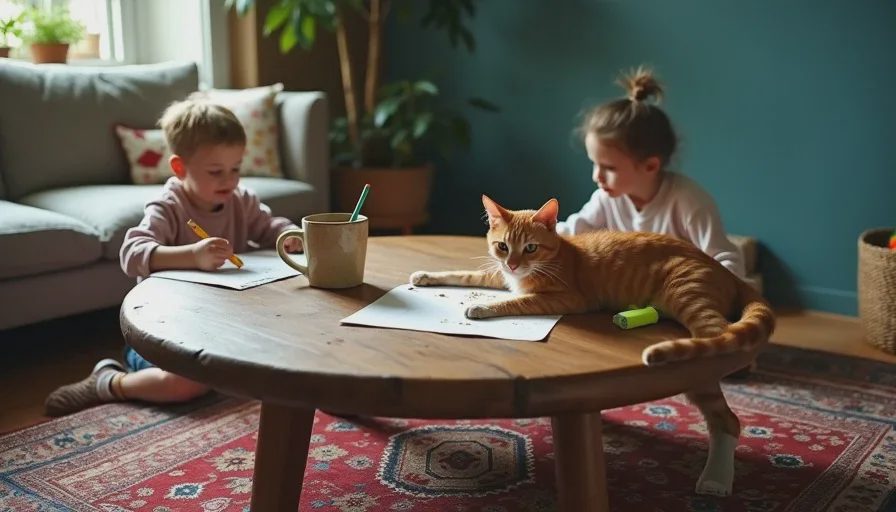
If I could go back eight years and have a conversation with the version of me who was pregnant with twins and pinning nursery photos on a Pinterest board, I'd say this: buy the washable rug, skip the velvet, anchor everything to the wall, and don't spend real money on anything that can't survive a stomach bug. The furniture you'll love most isn't the piece you agonized over in a showroom. It's the dresser that held up through three apartments, the sofa you didn't have to replace, the coffee table with no sharp edges that caught a falling toddler and let him bounce. Good design for families isn't about how it looks in photos. It's about how it survives Tuesday night when someone has a fever and the cat just threw up on the rug and you haven't slept in two days. Taste is free. Everything else, we thrift — and we buy fabric that wipes clean.

Letters
No letters yet — be the first to write.