A french country dining table should look like it has hosted thirty years of Sunday lunches, not like it arrived yesterday from a showroom with a fake crackle finish. I say this as someone who has spent far too many Saturdays measuring furniture in Brooklyn apartments. The right table is warm, practical, a little imperfect, and sturdy enough for homework, birthday cake, and a cat who believes every surface belongs to him.
My own table, Harold, cost $280 on Facebook Marketplace. He was honey-colored pine, covered in a shiny polyurethane coat, and described by the seller as “farmhouse.” That word was doing a lot of work. After sanding, two coats of muted cream paint on the base, and a matte clear finish on top, Harold became the french country dining table I wanted without the $2,000 price tag.
What Makes a Table French Country?
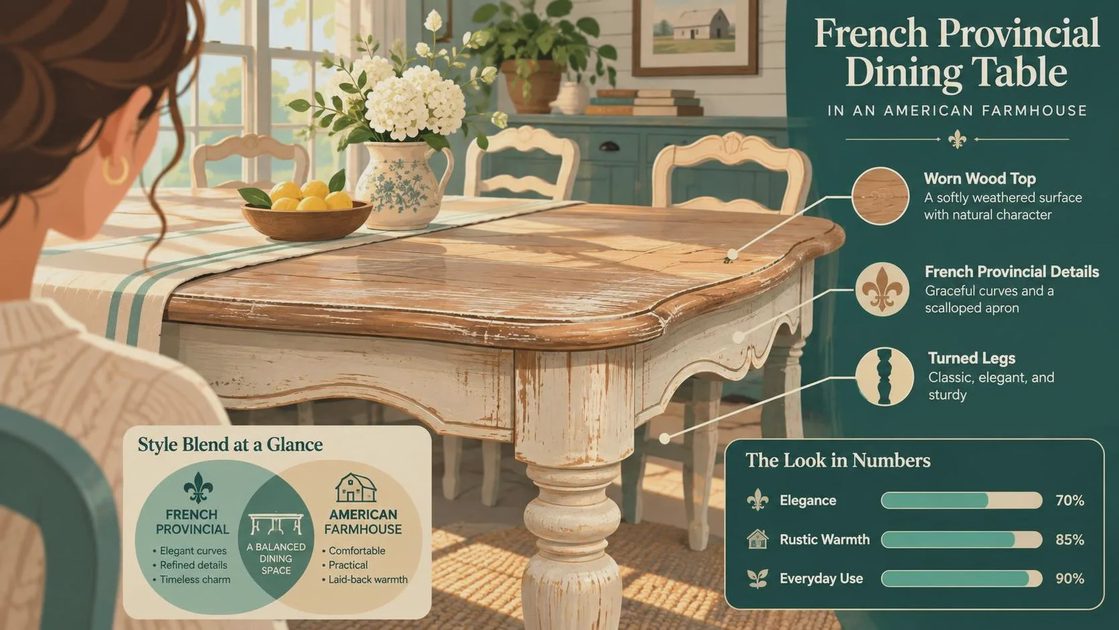
The style is less about a strict checklist and more about useful furniture with age in its face. Look for turned or gently tapered legs, a simple apron, softened corners, painted wood, warm oak, pine, or a combination of those materials. A little unevenness is welcome. A table that looks too perfect usually has too much finish, too many decorative details, or both.
I like tops that show grain and bases painted in cream, dusty blue, olive gray, or warm white. Pure bright white tends to make wood look yellow by comparison, especially under apartment lighting. If you are shopping for a french country dining table, ignore listings that rely on words like “rustic chic” and inspect the actual photos. Check the underside, the joints, and the way the legs meet the floor. A pretty finish cannot rescue a table that wobbles during soup.
A genuine antique is not required. In fact, many affordable tables from the 1980s and 1990s have the right proportions and can be improved with paint. Avoid anything made from thin particleboard if you want it to survive daily use. Veneer can be perfectly respectable, but damaged edges are harder to repair than solid wood.
Measure the Room Before You Fall in Love
This is where I have personally made the expensive mistake. A table can fit between four walls and still make the room impossible to use. Leave about 36 inches between the table edge and the nearest wall, cabinet, or radiator. That gives people enough room to pull out a chair without performing a sideways escape maneuver.
For four people, a table around 60 inches long is usually comfortable. Six diners generally need 72 to 84 inches, depending on the chair width. Round tables are excellent in small rooms because nobody gets trapped at the corner, but remember that a 48-inch round top takes more floor area than its measurements suggest once chairs are added.
Measure your elevator, stairwell, doorway, and the narrow turn into the dining area. I once bought a beautiful oak table in Crown Heights and discovered that its fixed top could not make the turn at the bottom of our stairs. Marcus removed the legs, which saved the purchase, but the whole operation involved a socket wrench, three neighbors, and language not suitable for a family blog. If the legs do not come off, walk away or bring a cardboard template before paying.
Where to Shop for the Best Price
Facebook Marketplace is my first stop because sellers often want large furniture gone quickly. Search “wood dining table,” “farmhouse table,” “painted dining table,” and “antique kitchen table,” not only the exact style phrase. The best french country dining table may be hiding under a boring listing with six blurry photographs.
Thrift stores and estate sales are better for older construction, but prices vary wildly. I have seen sturdy pine tables for $90 and wobbly decorative tables for $450 in the same weekend. Bring a tape measure, a flashlight, and a small level. Ask whether the seller has the extension leaves; replacement leaves can cost more than the table.
A useful budget is $100 to $350 for a basic secondhand table, $350 to $900 for a solid antique or carefully restored piece, and more for a new table from a specialty retailer. You do not need the most expensive option. You need the one with good bones and a finish you can live with while you save for repairs.
The Repairs That Matter
Sit at every side and press down on each corner. A little movement is fixable; a twisting frame with cracked joints is a project. Tighten accessible bolts first. For loose wooden joints, wood glue and clamps can work, but do not smear glue over a visible seam and call it finished. Wipe away squeeze-out before it dries.
Surface scratches are usually harmless. Water rings can sometimes be reduced with careful refinishing, but deep burns, split boards, and swollen particleboard are different problems. I would pay $40 for a table with ugly paint and solid legs before paying $250 for a flawless-looking table with a hollow core.
For a french country dining table, a few dents are part of the charm. I sand only sharp splinters and loose finish; I do not erase every mark. The goal is a table that can receive another mark without ruining your evening.
Paint, Stain, and Finish Without Making It Fake
Start by cleaning the table with a degreasing cleaner, then test your plan underneath. If you paint the base, lightly scuff the surface and use a bonding primer. I prefer a durable cabinet or furniture enamel in a low-sheen finish. Two thin coats beat one thick coat that stays tacky and shows every brush stroke.
For the top, I usually keep the wood visible. Sand only as far as necessary, stain if the color is uneven, and protect it with a water-based matte polyurethane or a hardwax oil suited to dining surfaces. Read the cure time, not just the dry time. A finish that feels dry after a few hours may still dent under a cereal bowl.
Do not distress every edge with sandpaper. That technique can make a new table look like it was attacked by a cheese grater. Let normal use create the wear. A french country dining table looks more convincing when the finish is restrained and the surface remains easy to wipe.
How I Would Style It Today
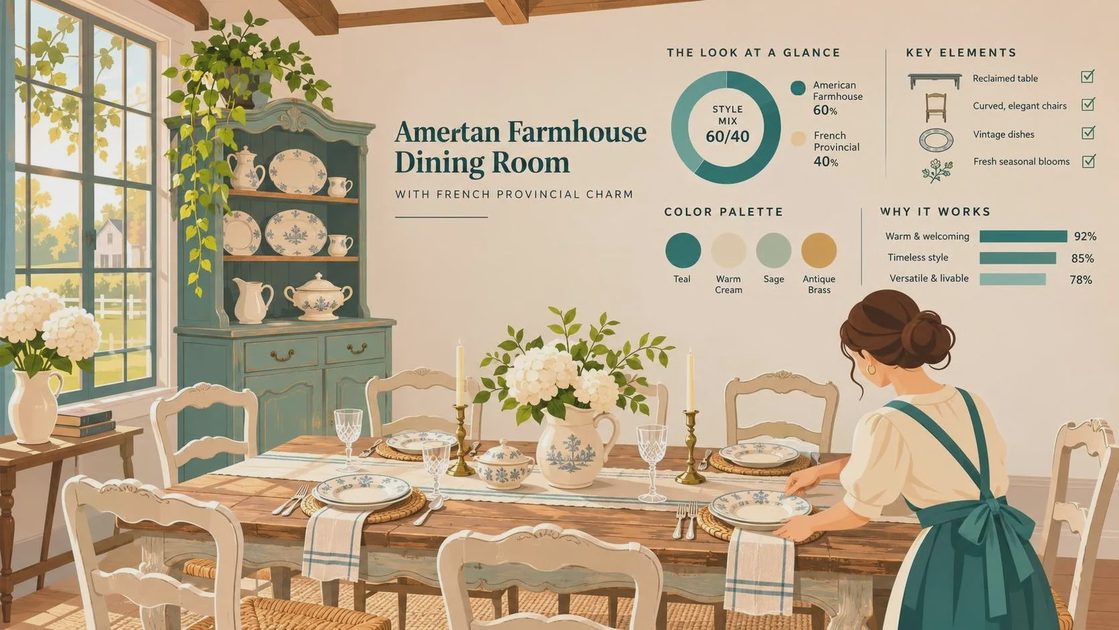
Use chairs that do not form a matching set. Two painted ladder-back chairs, a simple bench, and two bentwood chairs can look intentional without looking purchased in one afternoon. Keep the seat heights close, and check that arms slide under the table if you use armchairs.
For the centerpiece, choose one low object: a ceramic bowl, a glass vase with grocery-store branches, or a wooden board with lemons. A tall arrangement blocks conversation and gets knocked over by children. I learned that during a birthday dinner when Felix reached across the table and sent three tulips into the butter.
A washable cotton runner is more practical than a precious linen one for everyday meals. Add a pendant or chandelier that hangs roughly 30 to 36 inches above the tabletop, then use warm bulbs rather than icy daylight bulbs. The room should feel welcoming at night, not like a dental office.
My Buying Checklist
Before handing over money, confirm the table’s length, width, height, and leaf storage. Check every joint, look for insect damage, and smell the wood. A musty odor can linger after cleaning. Ask whether the table has lived in a basement or damp garage, where swelling and hidden mold are more likely.
Bring measurements for your chairs and room. Calculate delivery costs before declaring a $150 bargain. In New York, a local furniture mover can easily add $80 to $200, depending on stairs and distance. If the total still fits your budget, negotiate politely and be ready to pick up on the seller’s schedule.
The best french country dining table is not the one with the most ornate legs or the most convincing fake age. It is the table you can repair, feed people on, and look at every morning without regretting the purchase. Taste is free. Everything else, we thrift.



Letters
No letters yet — be the first to write.