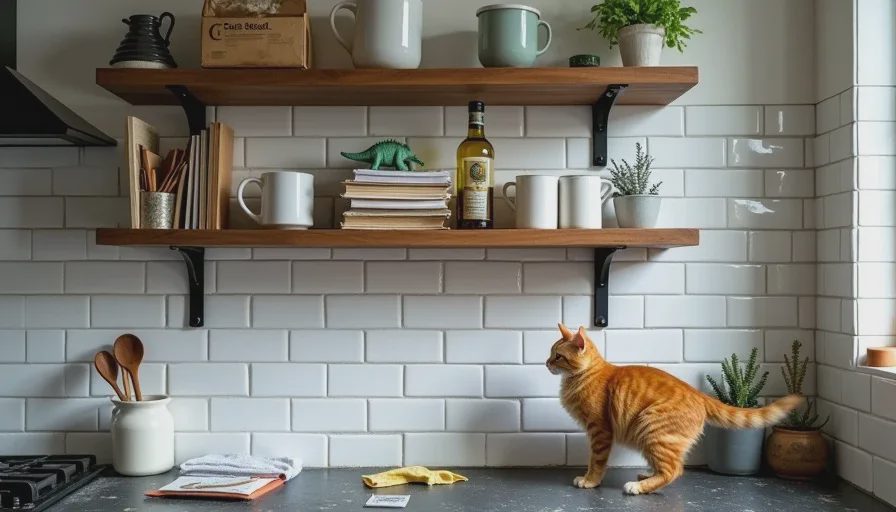
I have installed open shelving in my kitchen exactly twice. The first time, I was twenty-seven years old and living in a third-floor walk-up in Crown Heights, and I'd just discovered design blogs. I took down two perfectly functional upper cabinet doors, sanded the shelves, and arranged my "curated" collection of mismatched bowls and vintage glassware with the care of a museum exhibition designer. I posted a photo of it. People said "gorgeous" and "so airy" in the comments. I felt like a person who had her life together. Three weeks later, every single item on those shelves was coated in a film of greasy dust that smelled faintly of last Tuesday's stir-fry, and I was using a step stool to wipe down my coffee mugs before I could actually drink coffee from them. That was the end of open shelving round one. Round two happened six years later, after the twins were born, in a fit of optimistic amnesia. It lasted two months. I'm now on round three, which is the final round: cabinet doors, back on, never coming off again. This is my honest home design advice about open shelving, and I'm going to say what too many design publications won't: it's a lie. It's a beautiful, photographable, thoroughly impractical lie told by people who don't cook, don't have cats, and definitely don't have eight-year-olds who treat every horizontal surface as a landing zone for granola bar wrappers and plastic dinosaurs.
The Greasy Dust Problem (No One Warns You About This)
Here is what happens in a real kitchen. You cook things. Oil particles rise into the air. They're invisible in the moment, but they settle on every surface — including the surfaces four feet off the ground where you keep your "everyday" dishes. Over the course of about five days, those oil particles combine with regular household dust to form a substance I can only describe as kitchen smog residue. It's gray. It's slightly sticky. It clings to ceramic, glass, wood, and especially to anything with a matte finish. If you have open shelving, this substance is now living on the rims of your bowls, the handles of your mugs, the spines of your cookbooks. Everything you supposedly "use daily" needs to be washed before you use it, unless you enjoy the taste of airborne bacon grease with your morning cereal.
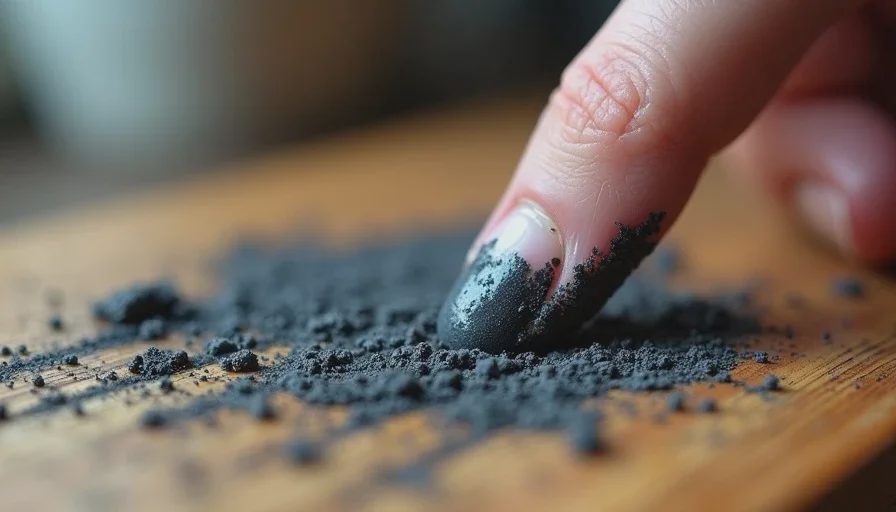
"But Naomi," you might be thinking, "I clean my kitchen regularly. I wipe down my shelves." So did I. I am a person who cleans. I am not a slob. And still, the open shelving defeated me, because the cleaning never ends. It's not a weekly task — it's a daily one. Every single morning, if you want your dishes to be clean, you're either wiping down every item on the shelf or washing it before use. In a household with two adults, two kids, and a cat who sheds approximately his body weight in fur every week, I do not have time to add "wipe the mugs" to my morning routine. I'm already negotiating with an eight-year-old about whether a granola bar counts as breakfast (it does, Cleo, but you also need to eat the granola bar, not just hold it while staring into space).
The Cat Factor
Even if you don't have kids — even if your kitchen is a sanctuary of adult calm — do you have a cat? Because if you have a cat, and you have open shelving, you no longer have open shelving. You have cat shelves. Gouache discovered this immediately during open shelving round two. The bottom shelf was empty because I'd run out of things I trusted him not to knock off, and he claimed it as his personal observation deck. From that shelf, he could survey the entire kitchen, monitor food preparation, and swipe at anyone who walked past. He also used it as a launch point to reach the middle shelf, where he once sent an entire stack of salad plates to their death. The plates were secondhand, so the financial loss was minimal, but the emotional toll of sweeping up shattered ceramic while a cat watched from the crime scene with zero remorse — that stays with you.
Cats also shed. And that fur, combined with the aforementioned greasy dust, creates a kind of felted coating on any shelf a cat has claimed. I pulled a supposedly clean serving bowl down before a dinner party once and found a wisp of orange fur stuck to the inside. I had to wash every dish while my guests were in the living room. Open shelving had turned me into a pre-dinner-party dishwashing panicker, which is exactly the kind of person I swore I would never become.
The "It Forces You to Declutter" Argument Is Nonsense
There's a claim that open shelving enthusiasts make, and it goes like this: "Open shelving forces you to keep only what you use and love, because everything is visible." This sounds wise. It is, in practice, deeply flawed. What it actually forces you to do is arrange your dishes like you're staging a home for a real estate open house every single day. Your mismatched cereal bowls — the ones you actually use, the ones that hold your oatmeal every morning — do not look "curated" when they're on display. They look like mismatched cereal bowls. The chipped mug from your college roommate that you keep because it holds exactly the right amount of coffee? It looks chipped. The plastic dinosaur that somehow migrated from the living room to the kitchen and now lives next to the olive oil? There is no aesthetic that accommodates a plastic dinosaur.
Real kitchens accumulate things that are useful but not beautiful. The half-empty bag of lentils. The box of tea your mother-in-law sent that you don't really like but can't throw away. The pile of school permission slips that needs to be signed by Tuesday. Open shelving takes all of this — the functional chaos of a working kitchen — and puts it on display. The only alternative is to hide everything in closed storage and keep the shelves styled with objects you never actually touch, which means you now have decorative shelves and a separate storage system for the things you use. At that point, just put doors on the shelves and call it a day.
What Actually Works Instead
I'm not going to tell you to rip out your open shelving and install custom cabinetry. This is renter-friendly home decorating and budget apartment decorating NYC — the reality for most of my readers is that you can't renovate your kitchen. Here's what you can do instead.
Option 1: Keep the Cabinets You Have
If you're lucky enough to have upper cabinets, do not take the doors off. I know the design blogs tell you removing cabinet doors "opens up the space." But you know what else opens up the space? Not having to wash every dish before you use it. If your cabinet doors are ugly — mine were, they were dark brown laminate from the 1990s — paint them. You can paint laminate. You need a good primer and some patience, but it costs about $40 and a weekend. Painted cabinet doors in a color you love will do more for your kitchen than any amount of "open" shelving.
Option 2: Glass-Front Cabinets
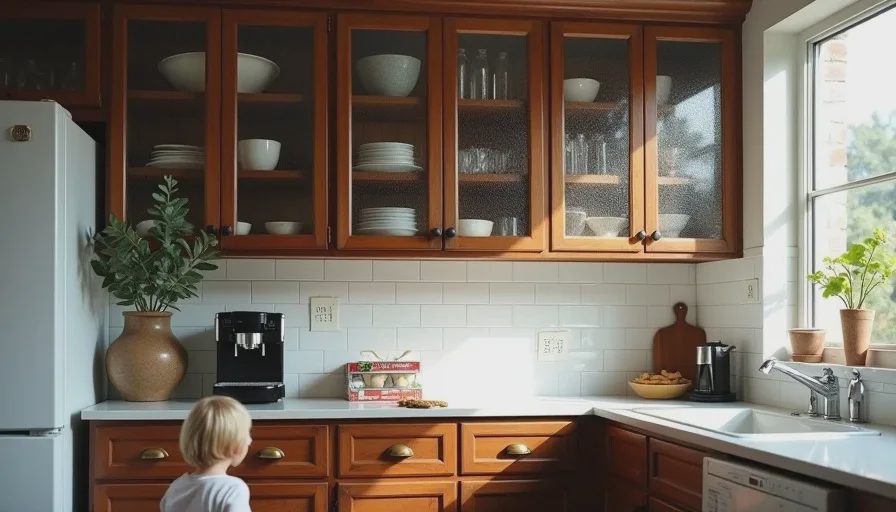
If you genuinely love the look of visible dishes — and I understand the impulse, some dishes are lovely — go for cabinets with glass doors. The textured or frosted glass is ideal because it gives you that airy look without requiring you to keep the shelves photo-ready. The glass catches the dust, not your dishes. You wipe the glass once a week, which takes thirty seconds, and everything behind it stays clean. Our current kitchen has a vintage hutch with textured glass doors that we found at a flea market for $60. It holds all our everyday dishes. They're visible but not exposed, and the glass has a wavy, old quality that makes even our mismatched bowls look charming.
Option 3: One Open Shelf, and Only One
If you absolutely cannot let go of the open shelving dream, limit yourself to a single shelf. One. Position it away from the stove, ideally on a wall that doesn't face the cooking zone, and use it only for things you use constantly — think salt, pepper, cooking oil, a utensil crock, your daily coffee setup. Things that get handled and washed so frequently that dust doesn't have time to settle. This is what I've done in our current kitchen. One shelf, above the coffee station, holds our mugs and a small plant. The mugs get used and washed daily. The plant gets watered and dusted. Everything else lives behind cabinet doors, where it belongs.
Who Open Shelving Actually Works For
In the interest of fairness, I'll acknowledge that open shelving does work for some people. Specifically: people who don't cook much, people who don't have children or pets, people who genuinely enjoy the ritual of styling and restyling their shelves, and people who live in climates without much airborne dust. If you're a single person who mostly eats takeout, has a cleaning service, and uses your kitchen primarily as a backdrop for Zoom calls — open shelving might be perfect for you. For the rest of us, it's an invitation to perpetual mild disappointment.
The Second Relapse, and What I Learned
Open shelving round two happened when the twins were about two years old. I was sleep-deprived, deep in the toddler trenches, and I'd convinced myself that taking the cabinet doors off would "brighten" the kitchen and somehow compensate for the fact that I hadn't had a full night's sleep in twenty-six months. I removed the doors from the upper cabinets one Sunday afternoon while Marcus was at the playground with the kids. I arranged our dishes. I stood back and felt a brief, familiar rush of satisfaction. And then I went to make dinner, and within twenty minutes there was a fine mist of olive oil settling on my freshly styled shelves, and I remembered, with the weight of someone recalling a traumatic event, exactly why I'd abandoned this idea in my twenties.
I put the doors back on two months later. I had to ask Marcus to help me realign the hinges because I'd stripped one of the screws taking them off. He did not say "I told you so," but he didn't need to. The look on his face said everything.
The Bottom Line
Decorating without sponsored products and real-world honesty means admitting when a trend is not designed for real life. Open shelving photographs beautifully. It looks effortless and European and sophisticated. But so does a white linen sofa, and I've already explained why that's a trap. Your kitchen is a workspace. It's where you feed your family, where your kids do homework at the counter, where your cat plots against your olive oil. It doesn't need to look like a magazine. It needs to work. Put doors on your cabinets, keep your dishes clean without extra effort, and spend the time you would have spent dusting on something you actually enjoy. Like thrifting. Or sleeping. Or watching your cat fail to open a cabinet door because you were smart enough to install a childproof latch.


Letters
No letters yet — be the first to write.