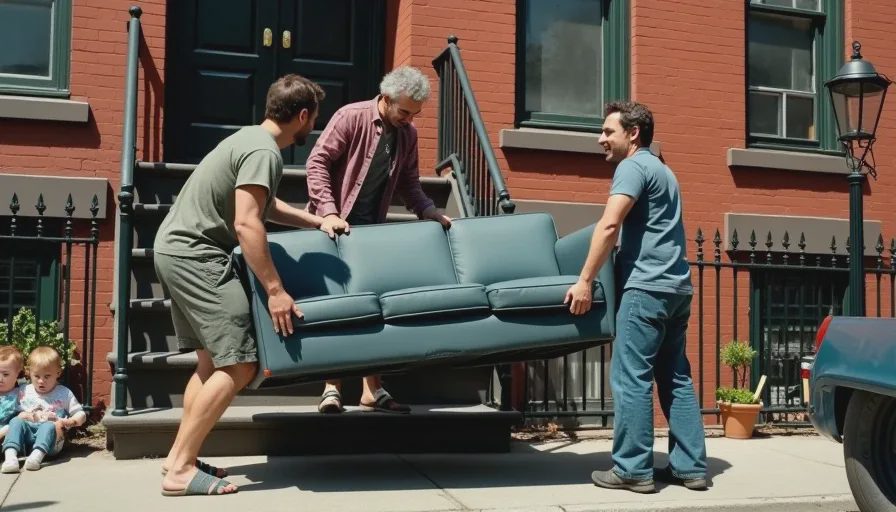
Some furniture finds feel like destiny. Most feel like you settled for whatever was available on Facebook Marketplace within a five-mile radius. But every so often, the universe hands you a genuine score — the kind that makes other people say "Wait, how much did you pay for that?" and you get to answer with a number that sounds like a typo. This is the story of my $75 sofa. It's the single piece of furniture people ask about most when they visit our apartment, and it's the reason I will never stop evangelizing about secondhand furniture tips and the art of walking around your neighborhood with your eyes open and your expectations low. This sofa has been spilled on, clawed, jumped on, slept on, and once used as a fort foundation for an entire rainy Saturday. Five years in, it's still here. Here's how it happened — and what the whole experience taught me about thrift store home decor ideas that actually work.
The Find: A Sunday Morning with No Agenda
It was early October, five years ago. The twins had just turned three, which meant they'd recently transitioned from "destroying furniture by accident" to "destroying furniture with intention." Our previous sofa — a beige microfiber sectional I'd bought new for $800 three years earlier — had not survived the transition. One of the seat cushions had collapsed entirely, creating a sinkhole that swallowed anyone who sat in the middle. The fabric was a roadmap of stains: purple grape juice blooming near the left arm, a dark ring from a tipped-over coffee mug, and a mysterious green smear that I'd stopped trying to identify. We needed a new sofa, but I was working on a tight illustration deadline and Marcus had just started a new job. We didn't have time to hunt, and we didn't have money to spend.
On a Sunday morning, I took the twins to get bagels. That was the only plan. Bagels, maybe a walk through the park if they finished breakfast without throwing anything. On the way back, about three blocks from our apartment, I saw a hand-painted sign taped to a stoop railing: "MOVING SALE — EVERYTHING MUST GO — SOFA $100 OBO." OBO means "or best offer," which in flea market language translates to "please haggle with me, I don't want to carry this back upstairs." The sofa was sitting right there on the sidewalk, a gray-blue three-seater with rolled arms and tapered wooden legs. It looked solid. It looked clean. It looked, for reasons I still can't fully articulate, like it belonged in our living room.
I parked the stroller. Felix was mid-bagel, cream cheese on his nose. Cleo was singing a song she'd made up about a cat named Potato. And I, in my bagel-run attire of leggings and Marcus's old sweater, approached the woman sitting on the stoop with a coffee and a clipboard.
"Does it smell?" I asked.
She laughed. "No. We've had it three years. No pets, no kids. We're moving to Portland and it's not coming with us."
I sat on it. The cushions were firm but comfortable. I knocked on the wooden frame — solid thud, not a hollow echo. I ran my hand along the seams, checked under the cushions (no horrors lurking), and turned to her. "Would you take seventy-five?"
She looked at me for maybe two seconds. "Sold. But you have to move it yourself, and it needs to be gone by noon."
It was 10:15 a.m. I did not have a car. I did not have a plan. I had two three-year-olds, half a bagel, and a sofa I'd just bought for $75.
The Haul: Never Underestimate a Neighbor with a Truck
This is where the story gets good, and where I need to acknowledge that luck is a real factor in Brooklyn flea market home finds — but also that luck favors people who talk to strangers. As I stood on the sidewalk calculating whether I could somehow carry a three-seat sofa three blocks while also pushing a double stroller (you cannot), a pickup truck pulled up to the curb. The driver was a man in his fifties with salt-and-pepper curls and a red flannel shirt. He was there to buy a floor lamp from the same moving sale. I introduced myself. I asked, with the kind of shamelessness that only comes from desperation, if he would be willing to help me move the sofa three blocks for twenty dollars.
His name was Ray. He'd lived in Fort Greene for thirty years. He had two grown kids and a grandkid on the way. And he said yes — not to the twenty dollars, which he refused, but to helping me because "that's what neighbors do." He and Marcus (who I called while Ray was loading the lamp into his truck) ended up carrying that sofa up our front steps while I held the door open with one hand and held Felix back from "helping" with the other. Cleo sat on the stoop narrating the whole operation like a tiny sports commentator. Gouache watched from the doorway, suspicious. By 11:30 a.m., the sofa was in our living room. By noon, the old beige sectional was on the curb with a "FREE" sign. Someone took it within an hour. This is New York. Nothing usable stays on the curb.
The Gamble: When You Don't Know What You're Buying
Buying secondhand upholstery is always a gamble. Bedbugs are the nightmare scenario — they're rare but real, and I've talked to enough New Yorkers with horror stories to take precautions seriously. When we got the sofa inside, I didn't let anyone sit on it for twenty-four hours. I inspected every seam with a flashlight. I vacuumed every surface, including the underside. I left it in the middle of the room, away from walls, and checked again the next morning. This might sound paranoid, but it's the single most important vintage furniture sourcing guide rule I have: treat every secondhand upholstered piece like it needs a quarantine period. I've brought home probably a dozen fabric pieces over the years and never had an issue, because I'm thorough to the point of obsession. The $75 sofa passed inspection. It was clean.
The other gamble was whether it would hold up. The previous owner had no kids and no pets. We had two three-year-olds, a cat, and a household that generates approximately seven times more spills than a childless home. The fabric was a cotton-polyester blend in a mid-tone gray-blue — not a performance fabric, not treated with anything special, just dense and tightly woven. I figured we'd get maybe two years out of it before needing to reupholster. That was five years ago. The sofa is still here, and the fabric has earned every stain it doesn't have.
The Cat-Scratch Repair That Actually Worked
About two years in, Gouache discovered that the left arm of the sofa was an excellent scratching surface. He has a scratching post. He has several scratching posts. He ignores all of them in favor of furniture, because he's a cat and cats have no respect for property. By year three, the left arm had a set of parallel scratch marks — not through the fabric entirely, but enough to make the weave look ragged. I considered reupholstering just that section, but I couldn't find matching fabric, and I wasn't about to spend $200 fixing a $75 sofa.
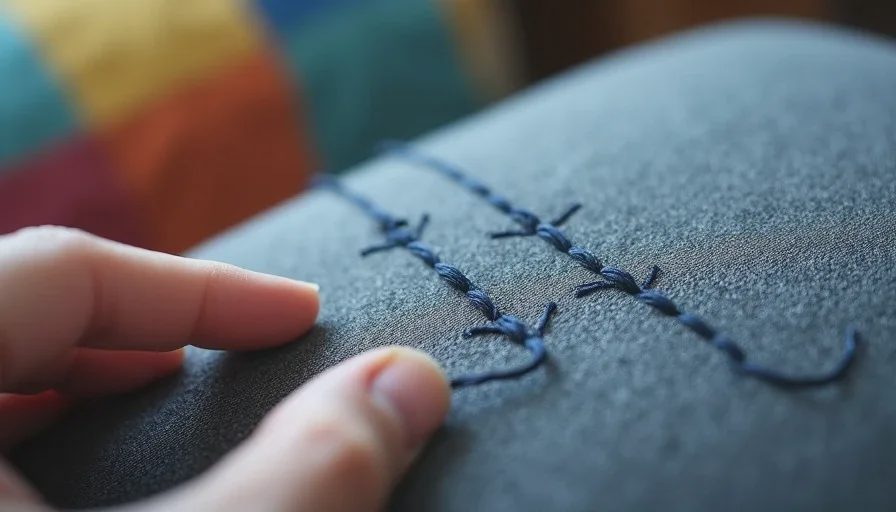
Instead, I bought a curved upholstery needle and heavy-duty navy thread at a sewing shop on Fulton Street — total cost, $6 — and spent a Sunday afternoon stitching the scratches closed. The result was not invisible. It was not elegant. The stitches were uneven, some tighter than others, with a little tuft of thread at the end where I'd tied the knot too large. But the fabric was stable again. The scratches stopped spreading. And the visible repair, which I'd initially been self-conscious about, became something I actually liked. It was proof that this sofa had survived something. It was mended, not replaced. That's the whole philosophy of realistic family home decorating in one seam: fix what you can, accept what you can't, and don't throw things away just because they show signs of life.
What the $75 Sofa Taught Me About Secondhand Shopping
This one find shaped how I think about every furniture purchase. Here's what I learned:
Price is not quality, but price also doesn't mean junk. Some of the most expensive furniture I've bought has been the least durable, and the cheapest has outlasted everything. The $75 sofa had a solid hardwood frame, good joinery, and fabric that was chosen by someone who didn't have to impress an Instagram audience. They just needed a couch that worked.
The best deals happen when you're not hunting. Every significant furniture find I've made — this sofa, the oak dresser, the vintage quilt that built my color palette — appeared when I was doing something else entirely. Walking to get bagels. Heading to the farmers market. Killing time before a doctor's appointment. There's something about the absence of expectation that lets you see things clearly. When you're desperate for a specific item, you overlook flaws and overpay. When you're just walking around with a coffee in hand, you can be picky.
Neighbors are the secret weapon of secondhand shopping. The people who live near you are constantly cycling furniture in and out of their lives. Stoop sales, building bulletin boards, the "free" pile in the laundry room of a co-op — these are richer sources than any curated vintage store. Ray, the man with the pickup truck, still lives three blocks away. We wave when we see each other. He once dropped off a set of old wooden hangers he was getting rid of, because he remembered I like old things.
The Sofa Now
Five years later, the $75 sofa is the heart of our living room. It's where the twins do their homework. It's where Marcus and I collapse after they're asleep. It's where Gouache holds court every afternoon in a sunbeam. The cushions have softened, the fabric has faded slightly along the back where the sun hits it, and the cat-scratch stitches are still holding. When friends come over, they don't ask where the sofa is from. They just sit on it, which is the highest compliment a piece of furniture can receive.

I could replace it now. I could afford something newer, something with a sleeker silhouette, something that wasn't chosen in a thirty-second negotiation on a Brooklyn sidewalk. But I won't. Because every time I look at that sofa, I see the Saturday morning I carried it home with the help of a stranger who became a neighbor. I see the afternoon I sat on it with a needle and thread and decided to fix it rather than replace it. I see my kids learning to read on it, my cat claiming it, my husband falling asleep on it after long work days. A $75 sofa isn't supposed to last this long. But sometimes, when you're doing budget apartment decorating NYC style — which is to say, real-people decorating in a city that punishes frivolity — the things you find by accident turn out to be the things you keep on purpose. Taste is free. Everything else, we thrift. Especially sofas.




Letters
No letters yet — be the first to write.