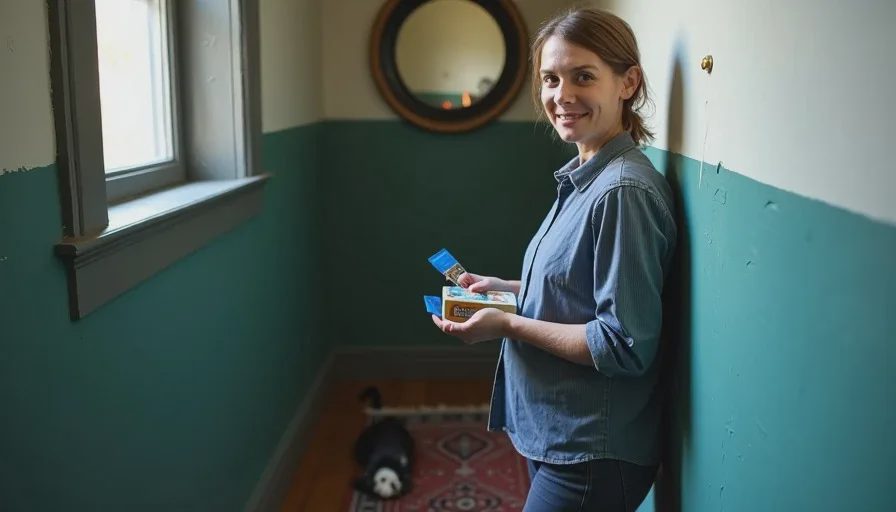
I killed a vintage mirror with a Command Hook. It was 2012, my second Brooklyn apartment, a third-floor walk-up in Crown Heights with crooked floors and a landlord who communicated exclusively through sticky notes left on the building's front door. I had found a beautiful oval mirror at a flea market — brass frame, beveled glass, probably from the 1940s, $15. I wanted to hang it in the hallway. I didn't want to put holes in the wall because I was twenty-five and terrified of my security deposit. So I bought a package of Command Hooks — the heavy-duty ones, the ones rated for sixteen pounds, the ones with the packaging that shows a mirror happily hanging above a credenza in a spotless, childless, earthquake-free home.
The mirror hung for three weeks. Then, at 2 a.m. on a humid July night, the adhesive gave out. The mirror hit the floor, shattered into approximately eight thousand pieces, and sent Gouache — then a kitten — rocketing under the sofa where he stayed for the rest of the night. I spent an hour sweeping up glass in my pajamas while Marcus stood in the doorway saying "I thought you said those things worked." The security deposit survived. The mirror did not.
That was the night I stopped treating my rental like a temporary holding cell and started treating it like my home. And I'm here to tell you what I wish someone had told me at twenty-five: your rental deserves better than Command Hooks. You deserve better than Command Hooks. And with about $20 in hardware, an $8 spackle kit, and the willingness to have one slightly uncomfortable conversation with your landlord, you can have real curtains, real shelves, and real art hung on real walls — without losing your deposit.
The Command Hook Lie We All Believed
Command Hooks are brilliant marketing wrapped around a fundamentally limited product. They were invented by 3M, a company that makes adhesives for a living, and they do exactly what they're advertised to do — hold a certain amount of weight under ideal conditions on a clean, smooth, non-porous surface. The problem is that most rental walls are not clean, smooth, non-porous surfaces. They're painted with cheap landlord-grade paint that has a slight texture. They've been exposed to humidity, temperature changes, cooking grease, and the fine layer of urban dust that settles on every surface in New York City. None of these conditions are ideal for adhesive performance.
The other problem with Command Hooks is more philosophical: they reinforce the idea that you don't really live in your rental. That your space is temporary, provisional, not worth investing in. That you should tiptoe around your own walls, apologizing for existing in a space you pay real money to occupy. Command Hooks are not a design solution. They're a dorm-room crutch that we've collectively accepted as a permanent feature of adult renting life. And every time I see a grown adult's apartment with art held up by adhesive strips, I want to hand them a drill and say, "You're allowed to live here. The walls are yours too."
What I've Hung in Four Rentals Without Losing a Deposit
Let me be specific about what I've done, so you know I'm not just giving theoretical advice. Over fourteen years and four Brooklyn apartments, I have:
Hung heavy mirrors using toggle bolts rated for 40+ pounds
Installed curtain rods with screws directly into wall studs
Mounted floating shelves that held books, plants, and a small collection of rocks the twins insisted on displaying
Hung a gallery wall of ten framed pieces, each with a nail or screw
Installed a coat rack in the hallway that has survived eight years of backpacks, winter coats, and at least one child attempting to swing from it
In every apartment, before I moved out, I spent one afternoon patching the holes. It took about two hours, cost less than $10 in materials, and every single landlord returned my full security deposit. One landlord, the sticky-note communicator in Crown Heights, actually thanked me for leaving the walls in "better shape than when you moved in" because I'd painted over the patches with touch-up paint that matched the wall color. (I had asked for the paint code before I moved in. Always ask for the paint code.)
The Tools You Need (About $30 Total)
This is the renter-friendly home decorating toolkit I've assembled over the years. It lives in a shoebox under the kitchen sink, and it has saved me more money and frustration than any other set of objects I own.
The basic kit:
A cordless drill or, if you're on a very tight budget, a good screwdriver with interchangeable bits ($15-$30). I used a manual screwdriver for my first three apartments. It takes longer but works fine.
A stud finder ($10). This is the thing that beeps when you run it over a wall stud. It's not strictly necessary — you can find studs by knocking and listening for the change in pitch — but it makes the job faster and gives you confidence.
A small level ($5). Nothing undermines a curtain rod like realizing it's slightly crooked every time you open the curtains for the next three years.
Assorted wall anchors and screws ($10 for a kit). Toggle bolts for heavy things. Plastic expansion anchors for medium things. Simple nails for very light things. The kit will come with instructions. Read them.
Pencil and masking tape. For marking where you're going to drill.
The repair kit (for when you move out):
A small tub of spackle or wall filler ($5-$8). This is the white paste that fills holes. It dries in about an hour.
A putty knife ($3-$5). The flat metal tool for applying spackle smoothly.
Fine-grit sandpaper ($3 for a pack). For smoothing the dried spackle so it's flush with the wall.
A small container of touch-up paint that matches your wall color. Ask your landlord for the paint code when you move in. If they won't give it to you, chip off a small piece of paint — from inside a closet or behind a switch plate, somewhere inconspicuous — and take it to a hardware store for color matching. A sample pot costs about $5.
That's it. For less than the cost of a large pizza and a bottle of wine, you can own the tools that let you treat your apartment walls like they belong to you — because for the duration of your lease, they do.
How to Hang Real Curtains in a Rental
Let's walk through a specific project: installing a curtain rod. This is the thing renters most commonly default to tension rods or Command Hook solutions for, and it's also the thing that makes the biggest difference when done properly.
First, find the studs. In most American construction, wall studs are vertical wooden beams spaced 16 inches apart inside the wall. They're what the drywall is attached to. Screwing directly into a stud is the strongest possible attachment — no anchor needed, just a screw into solid wood. Use your stud finder or the knock method. Studs usually run along both sides of a window frame, which is convenient for curtain rods.
If you can't hit a stud — and sometimes you can't, because windows aren't always framed the way you expect — use a toggle bolt or a heavy-duty wall anchor. A toggle bolt has a spring-loaded wing that opens up inside the wall cavity, distributing the weight across a larger area of drywall. These can hold forty pounds or more when installed correctly. Follow the instructions on the package. The key is to drill the hole the right size — too small and the toggle won't fit, too large and the toggle won't have anything to grip.
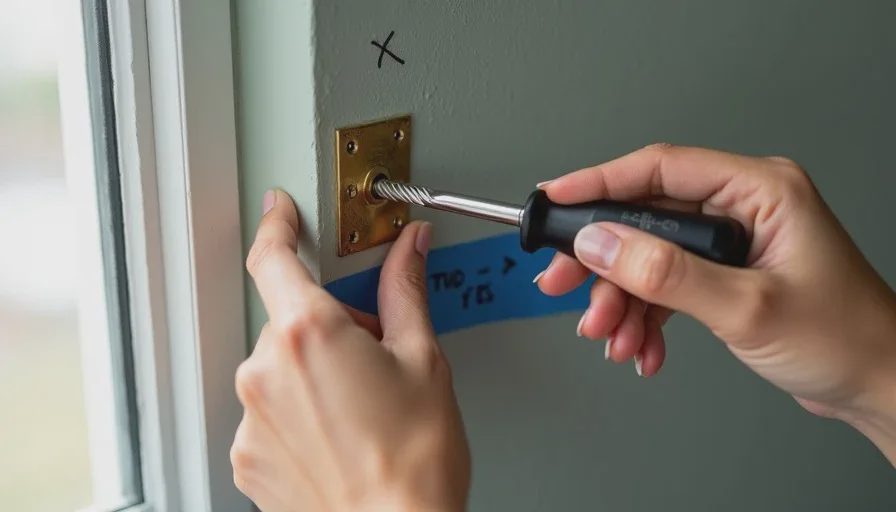
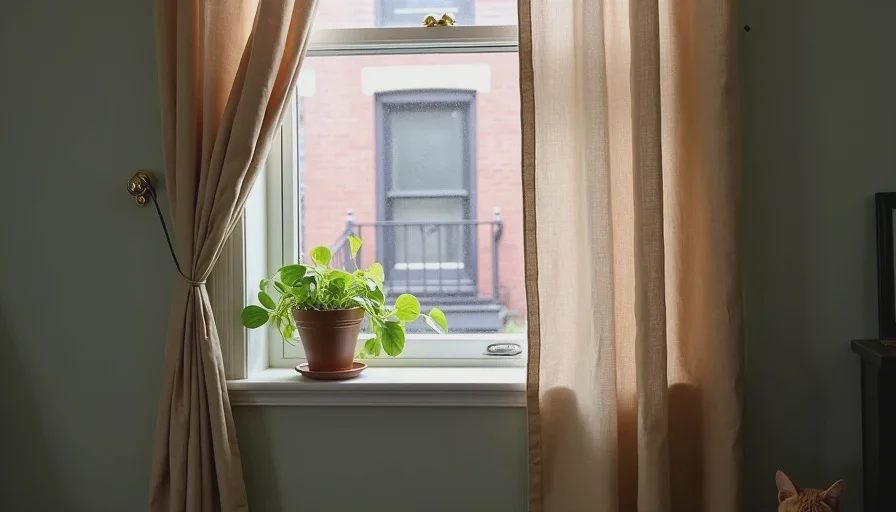
Once the brackets are up, the rest is easy. Slide the curtain rod through the curtains, set the rod in the brackets, level it, tighten the tiny set screws on the brackets that hold the rod in place. Stand back. You now have curtains that will not fall down, no matter how hard your cat tries to climb them. When you move out, unscrew the brackets, fill the holes with spackle, let it dry, sand it smooth, dab on touch-up paint. The whole removal process takes about thirty minutes of active work plus drying time. You will get your deposit back.
The Art-Hanging Hierarchy
Not everything needs a toggle bolt. Here's my weight-based system for hanging things in a rental, developed through trial and error and one shattered mirror:
Under 5 pounds (small frames, lightweight art, a single small canvas): A simple nail driven at a downward angle into the drywall. Yes, a nail. A small nail hole is the easiest thing in the world to patch — a dab of spackle, a swipe of your finger, done. Command Hooks are actually fine for this weight range if you must, but a nail is faster, cheaper, and leaves a hole that's just as easy to repair.
5 to 15 pounds (medium framed art, a small mirror, a lightweight shelf): A plastic expansion anchor with a screw. Drill a hole the size of the anchor, tap the anchor into the hole, screw into the anchor. The anchor expands inside the wall and grips the drywall. This is secure enough for most things you'd hang in a home.
15 to 40 pounds (large mirrors, heavy framed art, floating shelves that will hold books): A toggle bolt or a screw directly into a stud. Do not trust a Command Hook or a simple nail with anything in this weight range. The consequence of failure is broken glass, damaged floors, and a cat who won't come out from under the sofa.
Over 40 pounds (very large mirrors, upper kitchen cabinets, anything a child might try to climb): This is contractor territory. Talk to your landlord. If it's something you really want and the wall can support it, offer to pay for professional installation. Some landlords will split the cost with you because it improves the apartment. Some won't. Either way, don't DIY anything over forty pounds unless you genuinely know what you're doing.
The Landlord Conversation
Many renters avoid putting holes in walls because they're afraid of their landlord. I understand this. I have had good landlords and bad landlords, communicative landlords and landlords who responded to a leaking ceiling by suggesting I "put a bucket under it and wait for the rain to stop." But here's what I've learned: most landlords don't actually care about small holes in walls. They care about having to fix those holes between tenants, which costs them time and money. If you can demonstrate that you will fix the holes yourself before you move out, most landlords will be fine with you hanging things. Some will even be grateful — a tenant who patches their own holes is a tenant who saves the landlord a handyman call.
The conversation doesn't need to be formal. When I moved into this Fort Greene apartment, I told the landlord, "I'm planning to hang some curtains and art. I'll patch and paint any holes before I move out. Is there a specific paint color you use for touch-ups?" He gave me the paint code, said "just make it look like it did when you moved in," and never mentioned it again. That's the ideal outcome. If your landlord says no — and some will — you have to decide whether the risk of a small deduction from your deposit is worth the benefit of living in a space that feels like yours. In my experience, a few nail holes might cost you $50 off your deposit if the landlord is particularly petty. Fifty dollars, spread over a two-year lease, is about seven cents a day. For seven cents a day, you can have curtains that don't fall down.
The Mirror Lesson
I keep the memory of that shattered mirror with me — not as a reason to avoid putting holes in walls, but as a reminder that trying to avoid damage often creates more damage. If I had put a single toggle bolt in the wall in 2012, that brass mirror would still be hanging in someone's hallway today, reflecting morning light and making a small Brooklyn apartment feel twice as large. Instead, I listened to the adhesive strip packaging and ended up with a pile of glass at 2 a.m.
Your rental is not a hotel room. It's not a waiting area. It's your home, for however long you live there, and you have the right to make it feel like yours. Renter-friendly home decorating is not about avoiding all traces of your existence. It's about making the space work for you while you're in it, and leaving it in good condition when you go. The walls are yours. Hang the mirror. Use a toggle bolt. And keep a tub of spackle under the sink for the day you eventually move on.


Letters
No letters yet — be the first to write.