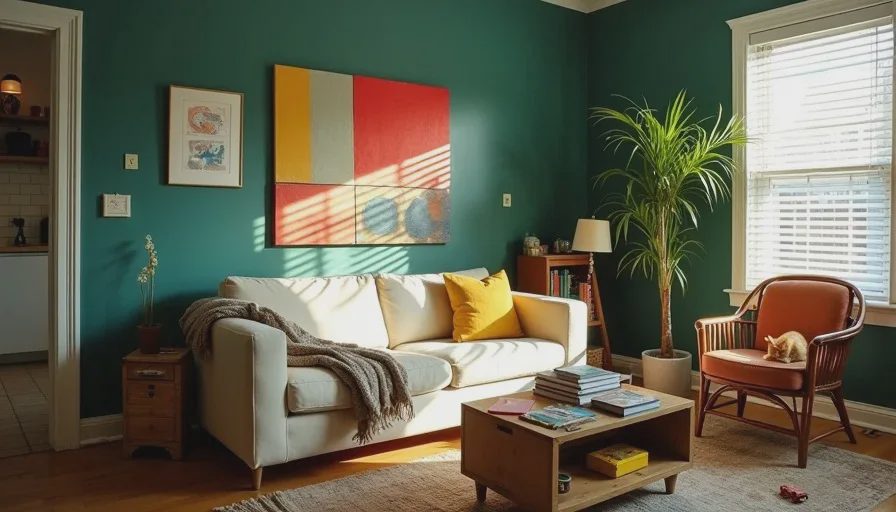
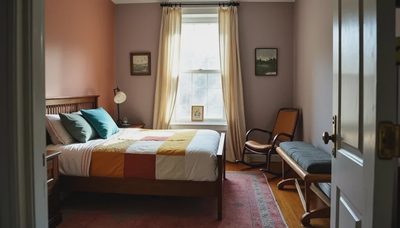
The living room you see now — the one people walk into and say "this feels like you" — took eighteen months to become itself. Not one weekend. Not one montage set to upbeat music. Eighteen months of wrong paint colors, furniture that didn't work, one glass coffee table that nearly killed a toddler, and a lot of sitting on the floor staring at blank walls waiting for them to tell me what they needed. This is the before-and-after that nobody posts on Instagram, because Instagram wants you to believe a room transformation happens between two frames of a Reel. But real no-spend room makeover work — the kind that doesn't involve a contractor named Sven and a credit card you're afraid to check — is slow, stubborn, and full of wrong turns. Here's every one of mine, and how the room finally became the one you see today.
Before: What We Moved Into
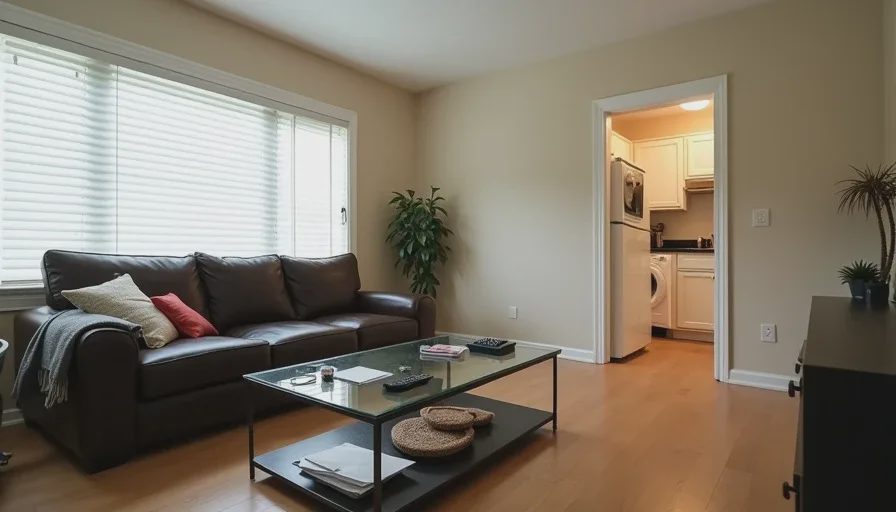
When we moved into this Fort Greene apartment five years ago, the living room was a box. A perfectly fine, perfectly forgettable box. The walls were "Landlord Beige" — that specific shade of pale tan that exists solely because it's the cheapest gallon at the hardware store and it hides drywall flaws in low light. The previous tenants had left behind a set of white plastic blinds and not much else. The floors were old oak, which was the one good thing, but they'd been hidden under wall-to-wall carpet for decades and needed work.
We moved in with whatever furniture had survived the last apartment: a dark brown faux-leather sofa that a friend had given us when she moved to Seattle (it was fine, just profoundly boring), a glass coffee table that I'd bought in my twenties because it looked "modern," a few mismatched bookshelves, and a floor lamp that flickered whenever anyone walked past. The twins were three. Everything we owned was either handed down, hastily purchased, or still in a box labeled "KITCHEN ???" that I found behind the couch six months later.
The room functioned. We sat in it. The kids played in it. But it didn't feel like ours. It felt like a waiting room for a life we hadn't started yet. Every time I walked in, I had the vague sensation that someone was going to ask me for my insurance card.
The First Step: Living in It Before Touching It
The single best piece of honest home design advice I can give you is this: don't decorate a room the month you move in. Live in it first. Watch where the light falls in the morning and where it goes in the afternoon. Learn which corner the kids gravitate toward and which wall the cat scratches. Figure out if you actually read in that armchair by the window or if it's just a very expensive laundry accumulation station.
I lived with the beige box for four months before I touched anything. During that time, I noticed things I wouldn't have caught on day one. The afternoon light on the south wall was so beautiful that it deserved to be the focal point — but it was being wasted on a blank expanse of beige. The corner by the kitchen entrance was constantly dark and would need help. The kids always played on the floor in the center of the room, which meant the coffee table needed to be something they couldn't hurt themselves on. And Gouache — who was a kitten then, all energy and claws — immediately claimed the spot by the window, which meant I needed to accept that whatever went there would be covered in orange fur.
The Color That Took Six Tries
I knew I wanted color on the walls. That was never in question. What was in question was which color. I went through six sample pots before landing on the deep blue-green that's there now. Six. Marcus thought I was losing my mind. Felix, who was three, learned to say "Mommy's painting the wall again" with the resigned tone of a war correspondent.
The wrong attempts, in order of appearance: a pale sage that looked like hospital scrubs in our light, a navy so dark the room felt like a cave by 3 p.m., a teal that was too green and made everyone look vaguely seasick, a dusty blue that was perfectly fine but somehow deeply boring, a charcoal that I liked but Marcus said felt like "working from home inside a thunderstorm," and — briefly, disastrously — a mustard yellow accent wall that I won't discuss further because Cleo still brings it up. ("Remember the yellow wall, Mommy? It looked like macaroni.")
The color that finally worked was a deep, dusty blue-green — Benjamin Moore's "Vanderlyn Blue," though I had it color-matched at a local hardware store for half the price. In the morning, it reads as a soft teal. In the afternoon sun, it goes deep and rich, almost like a forest. At night, with lamps on, it's warm and enveloping. It changes with the day, which means the room changes with the day, which means I never get tired of it. That's the quality you're looking for in a wall color: the ability to surprise you, but never in a bad way.
The Furniture: Everything Arrived Slowly, Everything Has a Story
The beige faux-leather sofa lasted about six months before I sold it on Facebook Marketplace for $50. It was replaced by The Sofa — the $75 stoop-sale find that I've already written an entire post about, so I won't rehash the whole story here. What I will say is that the sofa dictated a lot of what came next. Its gray-blue upholstery was the perfect support color for the deep teal walls. Its rolled arms and tapered legs had a kind of 1940s apartment-house charm that felt right for a Brooklyn brownstone. It wasn't trendy. It wasn't "mid-century modern." It was just a good, solid sofa with good bones and a color that played well with others.
The glass coffee table was the next to go. When Felix took his first wobbly running steps toward it and nearly brought it down on himself, I listed it that same afternoon and someone came to get it within three hours. (This is New York: list something free and functional, and it will vanish before you've finished your coffee.) I replaced it with the trunk coffee table you see in the photos — an old wooden storage trunk that I found at a flea market in Fort Greene for $30. It's solid wood, no sharp corners, and it opens up to store the kids' art supplies. It also looks better with every scratch, which is the hallmark of a good family furniture choice.
The rug came next. I spent a long time looking for the right one, because rugs are expensive and I didn't want to make a $300 mistake. I found the vintage Persian-style rug at a secondhand shop in Carroll Gardens for $80. It was faded in exactly the right way — the reds had gone soft and pinkish, the blues were dusty, and there was one small stain near the edge that the shop owner was honest about. ("Wine. 1980s, probably. Adds character.") The rug grounded the whole room. It gave the kids something soft to sit on, it gave the cat something to shed on that wasn't the sofa, and it brought in all the warm tones — brick, ochre, faded rose — that balanced the cool blue-green of the walls.
The Art Wall: A Family Project
The wall behind the sofa took the longest to figure out. I didn't want a gallery wall that looked like I'd planned it with a level and a spreadsheet. I wanted something that felt organic, something that could grow as the kids grew. What happened instead was this: Felix drew a picture of our building when he was four. It was a brown rectangle with seventeen windows (our building has six windows) and a sun that looked like a fried egg. I taped it to the wall above the sofa because I didn't have a frame and I wanted him to see it displayed. Cleo, not to be outdone, drew a cat that looked like a potato with legs and demanded equal wall space. So I taped hers up too.
Over time, more things joined them. A postcard from a friend's gallery show. A small abstract painting I did on a scrap of canvas. A Polaroid of Marcus and me from before the kids were born, looking impossibly young and well-rested. The large abstract piece above the sofa — the one people assume is a "real" artwork — is one of my own, painted during a period when I was experimenting with palette knife work. It's mostly brick red and deep blue and a slash of mustard yellow, and it ties the whole room together without trying to.
The art wall is the part of the room people comment on most, and it cost almost nothing. The kids' drawings are held up with washi tape. The frames for the postcards and photos were thrifted or found. The big painting was mine. That's the secret to realistic family home decorating: the best things on your walls are the things that mean something, not the things that match your sofa.
What I Spent (The Real Numbers)
People always want the budget breakdown, so here it is, as honestly as I can reconstruct it from five years of receipts and memory:
Paint and supplies: $85 (one gallon of deep teal, one gallon of primer, rollers, tray, tape, drop cloth)
Sofa: $75 (stoop sale)
Coffee table (trunk): $30 (Fort Greene flea market)
Rug: $80 (secondhand shop, Carroll Gardens)
Floor lamp: $25 (thrifted, Brooklyn Flea)
Bookshelf: $40 (Facebook Marketplace)
Curtains: $35 (oat-colored cotton, bought new — my one concession)
Curtain rod: $10 (thrifted)
Art and frames: ~$40 total (assorted thrift stores and flea markets over time)
Cushions and throw blanket: ~$50 (mix of thrifted and one new set of cushion covers)
Plant: $15 (a baby rubber tree that is now taller than Cleo)
Cat: Free (stray kitten found behind a bodega — the most expensive free thing I've ever acquired, considering the sofa scratching)
Total: approximately $485 over eighteen months. Even rounding up to $600 to account for the sample pots and the mistakes I've since sold or donated, this is a full living room transformation for less than the cost of one West Elm sofa. And nothing in this room was sponsored, gifted, or purchased with an affiliate link. That's the whole point of Thrifted & True: budget apartment decorating NYC doesn't mean sacrificing style. It means being patient, being picky, and knowing that the right thing will show up eventually if you keep your eyes open.
What I'd Do Differently
I'd skip the six sample pots and just live with the beige for another month while I figured out what I actually wanted. I'd buy the rug sooner — it transformed the room more than any single piece except the paint. And I'd tell myself, with more conviction, that a room doesn't need to be "done" to be good. The living room you see in these photos is still changing. We rearranged the furniture last month when Cleo decided she wanted a reading corner. The kids' art rotation changes every few weeks. The plant needs repotting. Gouache has scratched a new spot on the sofa arm that I'll need to stitch up. Good rooms are never finished. They're just well-loved, over time, by the people who live in them.
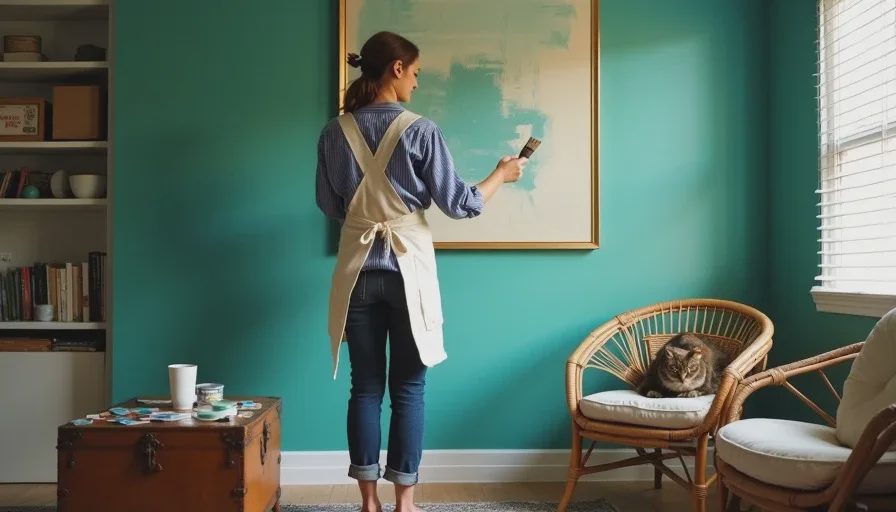
That's the thing about renter-friendly home decorating and real-life makeovers: they don't end with a big reveal. They end with you, in your paint-splattered apron, touching up a scratch on the wall three years later because your son threw a toy car and missed the couch. And you don't mind, because the wall color still makes you happy, and the scratch is tiny, and the room still feels like you — even more than it did when you first finished painting. Taste is free. Everything else, we thrift. And we touch up the paint when we need to.
Letters
No letters yet — be the first to write.