
Every few months, a well-meaning friend or a stranger in my DMs sends me a link to a "budget-friendly" home decor post from a popular Instagram account. "This seems up your alley!" they say. I click. I scroll. And then I do something that has become a ritual: I add up the total cost of the "budget-friendly" room, compare it to what I actually spent on my own living room, and laugh until I need to lie down. The last one I looked at was titled "Living Room Refresh Under $5K." Five thousand dollars. Under. As if that's a discount. As if "under $5,000" is a reasonable budget for a room refresh in a world where most people I know are trying to figure out if they can afford both rent and a new rug. This is the post where I open my actual spending logs — the real, handwritten, coffee-stained ledger I keep in my desk — and show you what budget apartment decorating NYC actually looks like when no one is paying you to decorate.
The Instagram Budget vs. The Real Budget
Let's start with a comparison that will make you either laugh or throw your phone across the room, depending on your mood. Here's the "affordable" living room budget from a recent Instagram post I screen-shotted and saved as evidence:
Sofa: $3,200 (brand not disclosed, but the "#gifted" tag in the comments gave it away)
Rug: $1,100 (with an affiliate link, naturally)
Coffee table: $850 ("vintage-inspired" — which means new, made to look old)
Floor lamp: $400 ("investment lighting")
Curtains: $250 (custom-length linen)
Art: $600 (a print, not even an original)
Throw pillows: $180 (three pillows at $60 each)
Plant + pot: $120 ("sourced from a local nursery")
Total: $6,700. For a room refresh. That's more than my first three months of rent in Brooklyn, adjusted for inflation. And the worst part? The room didn't even look interesting. It was beige. Beige sofa, beige rug, beige curtains, beige art. Beige on beige on beige, like a meditation on the absence of personality, yours for the price of a used Honda Civic.
Here's what I actually spent on my living room — the room you see in every photo on this blog, the room people walk into and say "this feels like you":
Sofa: $75 (stoop sale, Fort Greene, 2019)
Rug: $80 (vintage, secondhand shop, Carroll Gardens)
Paint and supplies: $85 (color-matched Benjamin Moore knockoff)
Coffee table (trunk): $30 (flea market, Fort Greene)
Floor lamp: $25 (thrifted, Brooklyn Flea)
Curtains: $35 (new — my one concession, oat-colored cotton, on sale)
Curtain rod: $10 (thrifted, brass, slightly tarnished)
Cushions and covers: $50 (mix of thrifted and one new set of covers)
Art and frames: $40 (assorted thrift stores over time, plus my own paintings)
Plant (rubber tree): $15 (bought as a baby, now taller than Cleo)
Cat: Free (stoop kitten, 2016 — though the sofa repairs have cost me about $6 in thread)
Total: approximately $485. Let's round up to $600 to account for the sample pots I wasted before finding the right wall color, and the candles I bought for the candlesticks. Six hundred dollars. For the entire room. That's less than the Instagram room's throw pillows.
Let's Talk About the Sofa Gap
The single biggest line-item gap between Instagram budgets and real budgets is always the sofa. Instagram sofas cost $2,500 to $5,000. Real sofas — the ones normal people sit on without flinching when someone holds a cup of coffee — cost whatever you can afford. I paid $75 for mine. I've written an entire post about it, so I won't rehash the whole story, but the key fact is this: my $75 sofa has a hardwood frame, tight joinery, and a dense cotton-polyester fabric that has survived five years of twins and a cat. The $3,200 Instagram sofa might have hand-tied springs and Italian leather, but it's also been photographed for a sponsored post, which means the person recommending it probably didn't pay for it.
Here's the thing about secondhand furniture tips that nobody tells you: the used market is flooded with quality pieces at a fraction of their original cost because furniture depreciates the moment it leaves the showroom. That's bad news for the original buyer. It's great news for you. A $3,000 sofa, used for three years by a family without pets, sells for $300 to $500 on Facebook Marketplace. A $1,200 rug becomes a $200 rug. A $600 coffee table becomes a $75 coffee table if you're willing to pick it up on a Saturday morning. The gap between "what things cost" and "what I pay for things" isn't luck. It's patience, persistence, and a willingness to let someone else take the depreciation hit.
Where Instagram Money Actually Goes
If you've ever wondered why Instagram budgets seem so disconnected from reality, I'll let you in on a secret I learned from a friend who works in influencer marketing. A lot of those "budget breakdown" posts aren't documenting actual purchases. They're listing the retail prices of gifted items — items the influencer received for free in exchange for featuring them. The prices are included because the brand wants viewers to know how much the item costs, so they might buy it. The post isn't a budget guide. It's an ad.
When you strip out the sponsorships, the affiliate links, the gifted items, and the quiet brand partnerships, you're left with something closer to what real people actually spend — which is a mix of secondhand scores, careful new purchases for things that matter, and a lot of patience. That's what decorating without sponsored products looks like. That's what real home decor blog no affiliate links means. Every number I'm about to share is something I paid with my own money, from my own bank account, with no one reimbursing me and no one giving me a discount code.
The Real Budget, Line by Line
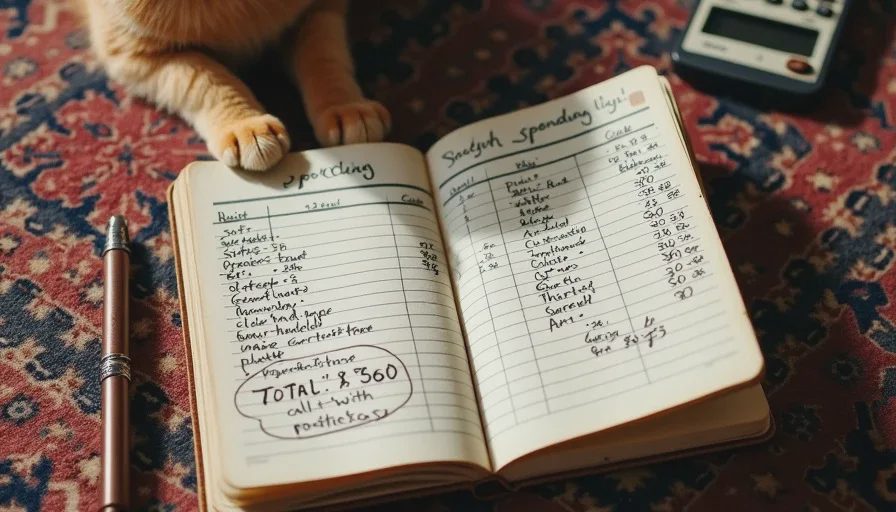
Let's go through the major categories and compare what I spent to what Instagram says a "budget" version costs. I'm using the screenshots I've collected over the past year as my Instagram reference points — these are real posts from accounts with tens of thousands of followers.
Sofa: $75 vs. $3,200
I covered this above, but let me add one detail. When I bought the $75 sofa, I also spent $5 on a bottle of fabric cleaner and three hours inspecting every seam with a flashlight. That's part of the real cost of thrift store home decor ideas — the labor of making sure you're not bringing anything unwanted into your home. Even if you add a $400 reupholstery job to my $75 sofa (which I did, three years later, when the original fabric started showing its age), the total is still under $500. For a sofa that will probably last another decade.
Rug: $80 vs. $1,100
Vintage rugs are the single best deal in home decor. A new wool rug in a traditional Persian or Turkish pattern can easily cost over a thousand dollars. A used one — with the same wool, the same hand-knotting, the same dyes — costs a fraction of that because it has a small stain, or the fringe is worn, or it's "out of style." None of those things matter when the rug is on your floor. The stains fade into the pattern. The fringe can be trimmed or repaired. And "out of style" is a meaningless concept when you're decorating a home, not a showroom. My $80 rug has a wine stain near one edge. The seller pointed it out. I didn't care. It's under the coffee table now, and no one has ever noticed.
Coffee Table: $30 vs. $850
The Instagram coffee table is always some sleek marble-and-brass situation or a "vintage-inspired" wood piece from a direct-to-consumer brand. Here's the thing about coffee tables: they are the most abused surface in a family home. They hold cups, plates, feet, art projects, homework, and occasionally a child standing on them to reach something they shouldn't. Spending $850 on a surface designed to be abused is, in my opinion, a waste of money. My $30 flea market trunk has been kicked, spilled on, colored on with marker, and used as a launch pad for fort-building. It looks better now than when I bought it, because the abuse has become a patina.
Art: $40 vs. $600
Instagram art budgets break my heart. $600 for a framed print — a reproduction of something someone else made, printed on demand, sold at a markup. For $40, I've filled my walls with original art: my own paintings, the kids' drawings, a postcard from a friend, a small landscape I found at a flea market for $8 that someone painted in 1973. The art on your walls should mean something to you. It shouldn't be a line item in a budget breakdown designed to funnel you to an affiliate link.
The Thing I'd Actually Pay For
I'm not against spending money. I spent $85 on paint and supplies — more than any single piece of furniture in the room, except the rug. Paint is worth paying for. Good paint covers better, lasts longer, and makes the whole room look more expensive than it is. I also spent $35 on new curtains, because I wanted a specific color and couldn't find it secondhand. And I spent $50 on cushion covers, some new and some thrifted, because cushions take the most abuse and I wanted ones that could survive a wash cycle. The principle isn't "never spend money." It's "spend money where it counts, and thrift everything else."
The Time Cost
There's a legitimate argument that thrifting takes time, and time is money. I don't disagree. Finding the right rug took me three months of periodic searching. The sofa was an accident — I wasn't even looking for one. Building a room this way is slow. But here's my counterargument: the time you spend thrifting is time you're not spending earning the money to buy the $3,200 sofa. If you make $30 an hour, that sofa costs you over 100 hours of work — more than two weeks of full-time labor. I spent maybe 20 hours total hunting for every piece in my living room, spread over eighteen months. That's a little over an hour a month. My hourly rate for thrifting — the money I saved divided by the time I spent — works out to something like $150 an hour. I don't know about you, but I don't make $150 an hour drawing. Thrifting isn't a time cost. It's a side hustle that pays in furniture.

What the Numbers Don't Show
The real difference between a sponsored budget and a real budget isn't just the dollar amounts. It's what you get for the money. The $6,700 Instagram living room looked like a furniture showroom — clean, coordinated, and completely anonymous. You couldn't tell who lived there. You couldn't tell if anyone lived there. My $600 living room looks like me. It has the kids' drawings on the wall and the cat-scratched sofa arm and the vintage rug with the wine stain and the trunk that smells faintly of old wood every time I open it. It has personality. It has history. It has stories.
I'm not saying you should never buy new furniture. I bought new curtains. I bought new paint. I've bought new cushion covers and new light bulbs and new batteries for the smoke detector that won't stop chirping. What I'm saying is that the gap between the Instagram budget and the real budget isn't about taste. It's about sponsorship. Those budgets exist to sell you things. My budget exists to show you that realistic family home decorating can be done for less than the cost of one "investment" sofa. Taste is free. Everything else, we thrift. And I have the receipts to prove it.




Letters
No letters yet — be the first to write.